BitFlip27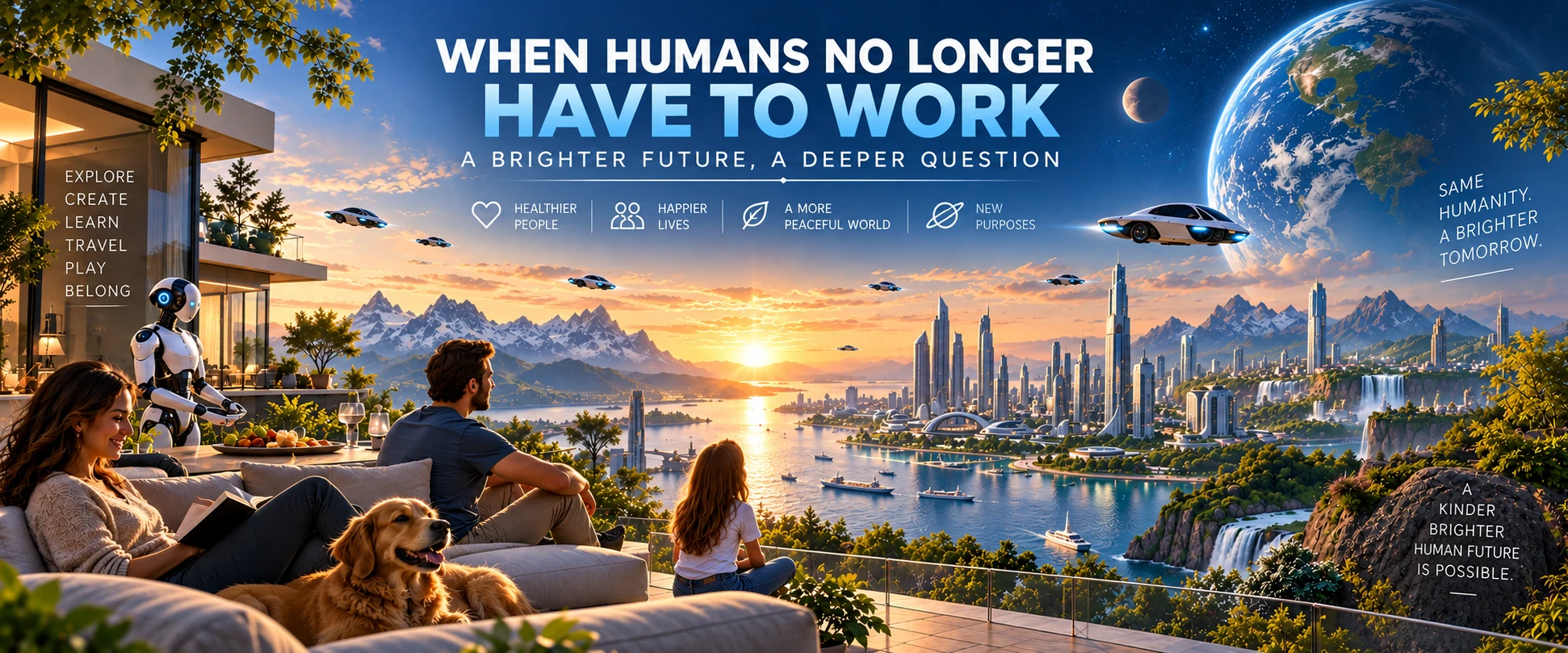
For most of human history, survival has required work.
We hunted because we needed food. We farmed because we needed crops. We built shelters because we needed protection. We created tools, factories, companies, transportation systems, hospitals and governments because civilization required human labor to function.
Even in the modern world, where many of us are far removed from hunting and farming, the basic equation remains remarkably similar:
We work because we need resources to live.
But imagine that one day this equation disappears.
Not because everyone becomes wealthy in the traditional sense, but because artificial intelligence, robotics and advanced automation become capable of providing the basic material needs of civilization at extraordinary scale.
Imagine autonomous farms producing food with almost no human labor.
Robots construct homes.
Automated factories manufacture clothing, appliances, vehicles and machines.
AI systems help design medicines and treatments, while robotic medical systems provide high-quality healthcare.
Autonomous transportation takes us wherever we want to go.
Energy becomes abundant through advanced solar, nuclear, fusion or technologies we have not yet invented.
Machines maintain roads, electrical systems, water supplies and communications infrastructure.
Robotic systems perform dangerous mining, construction and industrial work.
AI scientists work alongside human researchers to understand disease, aging, physics and the universe.
Eventually, perhaps machines could even construct spacecraft, maintain planetary defenses against dangerous near-Earth objects and help humanity explore other worlds.
Now take the thought experiment one step further.
Imagine that the productivity of this civilization becomes so enormous that every person can be guaranteed a comfortable standard of living.
Nobody is hungry.
Nobody is homeless.
Everyone has excellent healthcare.
Every family can have a modest but comfortable home.
Transportation is universally accessible.
Perhaps personal autonomous aircraft eventually become as ordinary as automobiles are today.
Education is available to everyone through extraordinarily capable AI tutors.
People can travel, study, create, play sports, write books, paint, compose music, conduct experiments or simply spend time with their families.
Money might still exist for scarce luxuries, unique objects or limited resources, but it would no longer determine whether someone eats, receives medical treatment or has somewhere to sleep.
And then humanity would encounter a question that may be much more difficult than building the machines themselves:
What do humans do when humans no longer have to work?
Work Is More Than a Paycheck
We usually describe work economically.
A person performs labor and receives compensation.
But psychologically, work does much more than generate income.
Consider one of the first questions people frequently ask when meeting someone:
“What do you do?”
We rarely mean:
“What activities occupy your consciousness?”
We usually mean:
“What is your job?”
And the answer immediately becomes part of that person’s identity.
“I am a doctor.”
“I am an engineer.”
“I am a teacher.”
“I am a carpenter.”
“I am a programmer.”
“I am a journalist.”
Notice the language.
We don’t merely say that we perform engineering or medicine.
We often say:
I am an engineer.
I am a doctor.
Work has become intertwined with identity.
That creates an interesting problem for a post-work civilization.
Suppose an AI medical system can diagnose many diseases more accurately and rapidly than humans, robotic surgeons can perform procedures with extraordinary precision, and automated laboratories continuously develop new treatments.
A doctor may no longer be needed in the economic sense.
But that doctor spent perhaps 15 years becoming a physician.
Medicine may represent achievement, sacrifice, social contribution and identity.
What happens when society says:
“Thank you. The machines can handle it now.”
The economic problem might have been solved.
The psychological problem has only begun.
The Crisis of Purpose
Consider two people.
Person A
Maria works 50 hours every week.
She wakes at 6:00 a.m., prepares her children for school, drives through traffic, works all day and worries about her mortgage.
Sometimes she dreams:
“If I didn’t have to work, I would finally live.”
Now imagine Maria wins a permanent place in our hypothetical automated civilization.
Her home is guaranteed.
Food is abundant.
Healthcare is universal.
Transportation costs essentially nothing.
Her children receive excellent education.
She never has to work again.
The first few months might feel like paradise.
She sleeps late.
She travels.
She watches movies.
She visits friends.
She relaxes.
But after six months something unexpected might happen.
Maria wakes up one morning and asks:
“What am I supposed to do today?”
Then eventually:
“What am I supposed to do with the next 40 years?”
That is a fundamentally different problem.
We Might Discover That Humans Need Challenges
Human beings do not seem to seek comfort exclusively.
We deliberately create difficulty.
People climb mountains even though helicopters exist.
They run marathons despite having cars.
They solve puzzles that have no practical purpose.
They play chess.
They train for years to master musical instruments.
They build complicated objects for fun.
They compete in sports.
They play difficult video games and become frustrated when games are too easy.
This reveals something interesting about human psychology:
We don’t merely want rewards. We often want rewards that required something from us.
Imagine two scenarios.
In the first, someone gives you a medal.
In the second, you train for three years, run a marathon and receive the same medal after crossing the finish line.
Physically, the medals might be identical.
Psychologically, they are completely different objects.
One represents possession.
The other represents achievement.
That distinction could become enormously important in a civilization where machines provide nearly everything.
Perhaps Work Would Not Disappear—Obligation Would
There is another possibility.
Maybe humanity would continue working.
The difference would be that we would no longer have to work to survive.
That distinction changes everything.
Imagine someone who loves architecture.
Today, becoming an architect involves economic calculations.
Will the degree be affordable?
Can I find employment?
Will the salary pay my bills?
In a post-scarcity society, the question becomes:
“Do I want to spend ten years learning architecture because architecture fascinates me?”
A person could study architecture for 15 years without worrying about earning money.
Another person might become a marine biologist.
Another might restore forests.
Someone else might spend decades studying ancient languages.
Another might build experimental robots.
Someone might write novels that only 300 people ever read.
And that would be perfectly acceptable because those novels would not need to generate income.
Work could transform from economic necessity into voluntary human activity.
What Would Happen to Education?
Education might undergo one of the greatest transformations.
Much of today’s educational system is connected directly or indirectly to employment.
Children study.
They graduate.
They attend college or learn a trade.
They obtain credentials.
They compete for jobs.
But what happens when employment is no longer the primary objective?
Education could become lifelong.
A 70-year-old might decide to study astrophysics.
A 22-year-old might spend five years studying Renaissance painting.
A mechanic might spend a decade learning molecular biology simply because it is fascinating.
Instead of asking children:
“What do you want to be when you grow up?”
perhaps we would ask:
“What do you want to understand?”
That would represent an extraordinary cultural change.
Status Would Probably Survive Money
Removing economic scarcity would not necessarily remove human competition.
Humans compare themselves with one another.
If everyone had comfortable housing, excellent healthcare and transportation, people might begin competing over things machines cannot simply distribute.
Reputation.
Athletic achievement.
Scientific discovery.
Artistic recognition.
Social influence.
Knowledge.
Beauty.
Adventure.
Leadership.
Creativity.
Imagine a society where nobody cares much about someone’s bank account.
Instead, social prestige might come from saying:
“She discovered a new species.”
“He composed an extraordinary symphony.”
“She climbed Olympus Mons on Mars.”
“He developed a new mathematical proof.”
“She coached the community football team to a championship.”
“He spent ten years restoring an ecosystem.”
Competition might not disappear.
The scoreboard would change.
Sports Could Become More Important Than Ever
Sport is an excellent example because it already demonstrates how humans create meaning from voluntary difficulty.
There is no survival requirement for kicking a ball into a goal.
Civilization does not depend upon running 100 meters faster than another person.
Yet billions of people care deeply about sports.
Why?
Because sports contain many ingredients humans seem to value:
challenge, improvement, uncertainty, teamwork, discipline, identity, competition and achievement.
In a post-work civilization, physical competition could become even more culturally important.
People might spend years becoming exceptional runners, swimmers, football players, martial artists, climbers or participants in entirely new sports.
Physical achievement could also provide something an automated civilization might desperately need:
a reason to struggle voluntarily.
Art Might Experience a Renaissance
Suppose AI can produce technically perfect paintings, novels, music and films.
Would human art become meaningless?
Possibly the opposite.
If a machine can create ten thousand beautiful paintings every second, then technical perfection becomes abundant.
But a painting made by a human being might matter precisely because someone chose to spend six months creating it.
The story behind creation becomes part of its value.
Imagine someone saying:
“This painting was created by Ana. She spent three years traveling through South America before painting it.”
The scarcity is no longer the image.
The scarcity is Ana’s human experience.
The same could happen with books.
AI might generate unlimited stories, but readers could still care deeply about books written by humans because literature is not merely information.
It is one human consciousness attempting to communicate something to another.
Families and Communities Could Change
One of the greatest benefits could simply be time.
Parents could spend more time with children.
Adults could spend more time with aging parents.
Friends could see each other regularly.
People could participate in community projects.
Loneliness might decrease if society designed this transition well.
But there is no guarantee.
Technology could produce the opposite.
A person with unlimited entertainment, AI companions, virtual reality and no requirement to leave home might become profoundly isolated.
A civilization capable of providing everything physically necessary could still fail to provide belonging.
Machines could provide food.
They could provide medicine.
They could provide entertainment.
But meaningful relationships cannot simply be delivered like electricity.
The Psychological Risks Could Be Serious
This hypothetical future should not automatically be described as paradise.
Removing work could remove several structures that currently organize human life.
Work gives millions of people:
routine,
social interaction,
responsibility,
deadlines,
goals,
recognition,
status,
a sense of usefulness,
and reasons to leave the house.
Removing those structures suddenly could produce psychological difficulties for some people.
Consider retirement.
Some people flourish after retiring.
They travel, exercise, volunteer, study and spend time with family.
Others struggle because the professional identity that structured their lives suddenly disappears.
A post-work civilization could face a similar challenge on an unprecedented scale.
The important distinction is that freedom from unwanted labor does not automatically create purpose.
A civilization capable of eliminating poverty would still need to help people build meaningful lives.
Would We Become Lazy?
Perhaps some people would.
And perhaps that would be acceptable.
Someone might spend three years relaxing, playing games and watching movies.
If robots are producing the food and maintaining civilization, why should society necessarily object?
But over long periods, many people might eventually seek something more challenging.
The more interesting danger may not be laziness.
It may be passivity.
There is a difference.
Rest can be pleasurable and healthy.
Passivity is when nothing feels worth pursuing.
A society that eliminates economic necessity may therefore need to become exceptionally good at helping people discover curiosity, mastery, relationships, responsibility and purpose.
Humans Could Invent New Problems
There is another possibility that history strongly suggests:
When humans solve old problems, we create new ambitions.
Imagine telling a person living 20,000 years ago that someday humans would have supermarkets containing food from across the planet, antibiotics, airplanes, computers and instantaneous global communication.
They might reasonably conclude that humanity had solved almost everything.
We know that isn’t true.
Each technological level creates another horizon.
A post-scarcity civilization might ask questions that seem almost absurd today.
Can we eliminate cancer completely?
Can humans remain healthy for 150 years?
Can we restore extinct ecosystems?
Can we prevent dangerous asteroids from ever threatening Earth?
Can we establish permanent settlements on Mars?
Can we travel to another star?
Can we build artificial ecosystems in space?
Can we understand consciousness?
Can we discover whether life exists elsewhere in the universe?
Can we send autonomous scientific probes to thousands of planetary systems?
Suddenly humanity has plenty of work again.
The difference is that this work isn’t required to pay rent.
It is chosen because we want to know what is possible.
Robots Could Become the Infrastructure of Civilization
In this scenario, robots would not merely be household servants.
They could become something resembling civilization’s automated nervous system.
Mining robots acquire raw materials.
Construction robots build structures.
Agricultural machines produce food.
Manufacturing systems transform materials into products.
Autonomous logistics networks distribute them.
Maintenance robots repair infrastructure.
AI systems coordinate energy production.
Medical machines protect human health.
Scientific systems continuously conduct experiments.
Planetary-defense systems monitor near-Earth objects.
Space robots manufacture spacecraft.
Eventually autonomous factories might operate on the Moon, asteroids or Mars, extracting resources without requiring dangerous human labor.
Human civilization could become enormously productive while requiring relatively little compulsory human work.
Would Money Disappear?
Possibly—but not necessarily.
Money exists partly because resources are scarce and societies need mechanisms for allocating them.
If automation made food, basic housing, energy, healthcare, education and transportation extremely abundant, money might become far less important for survival.
But scarcity would probably continue somewhere.
There might only be 100 beachfront houses in a particular location.
A famous artist can create only so many original paintings.
Only a limited number of people can physically visit Antarctica at one time.
Land, unique objects, attention and certain experiences may remain scarce.
Money—or another allocation mechanism—could therefore survive.
The more plausible transformation might not be a world without money.
It could be a world where lack of money no longer means lack of life’s necessities.
That alone would radically transform civilization.
What Happens to Nations?
If energy, manufacturing capacity, food and essential resources became abundant, some economic reasons for geopolitical competition could diminish.
But scarcity is not the only cause of conflict.
Humans and states also compete over territory, political power, security, ideology, history, identity and influence.
AI and automation therefore would not automatically eliminate war.
However, a world where nations are less dependent upon scarce industrial resources could change some incentives.
If every region can produce abundant energy and automated factories can manufacture essential goods locally, controlling distant resources may become less economically important.
Whether that creates a more peaceful civilization would still depend upon human institutions and choices.
The Flying-Car Tuesday
Imagine an ordinary person named Daniel living in 2150.
Daniel wakes at 8:30.
He doesn’t have a job.
His home monitors its own energy use and performs most maintenance automatically.
His AI assistant reports that his health indicators are normal.
Daniel eats breakfast produced largely by automated agriculture.
At 10:00 he practices tennis.
At noon he joins three friends studying astronomy.
In the afternoon his autonomous aircraft takes him to another city.
He spends two hours helping design an educational game about the oceans of Europa.
Nobody pays him.
Nobody needs to.
He works on it because he finds it fascinating.
In the evening he has dinner with his family.
Before sleeping, Daniel spends an hour writing a historical novel he has been working on for seven years.
Only a few thousand people may ever read it.
He doesn’t care.
He loves writing it.
Was Daniel unemployed?
Technically, perhaps.
Was Daniel unproductive?
Certainly not.
And was his day meaningless because none of his activities generated a salary?
That question exposes how deeply modern civilization has connected economic productivity with human worth.
Perhaps We Would Need a New Definition of Success
Today success is frequently measured through accumulation.
Salary.
House.
Car.
Career title.
Business ownership.
Net worth.
But if everyone already has a home, transportation, healthcare, food and education, those measurements lose some power.
Perhaps people would measure their lives differently.
What did you learn?
What did you create?
Whom did you help?
Where did you travel?
What did you discover?
What relationships did you build?
What difficult thing did you accomplish?
What did you teach someone else?
What did you contribute to your community?
What mysteries did you spend your life trying to understand?
Those are not necessarily worse measurements of a human life.
The Most Dangerous Question: What If Everything Becomes Too Easy?
There is one final problem.
Difficulty gives experiences contrast.
Food tastes different when you are hungry.
Rest feels different after physical effort.
Achievement feels different after failure.
Financial security feels different to someone who remembers insecurity.
If technology removed nearly every form of involuntary hardship, future generations might never experience that contrast.
Would they appreciate abundance?
Would humans intentionally create controlled challenges?
Perhaps schools would place greater emphasis on difficult physical expeditions, competitive sports, wilderness experiences, engineering challenges, artistic mastery and service to others.
Not because suffering is inherently good, but because effort may be psychologically important even when survival no longer requires it.
Humanity might eventually discover that the objective should never have been to eliminate effort.
It was to eliminate unnecessary suffering and involuntary deprivation.
Those are very different goals.
The Great Transition
Perhaps the hardest generation would not be the people born into this world.
It would be us.
Imagine spending your entire life learning that responsible adults work, earn money, pay bills and accumulate savings—only to watch that system gradually become unnecessary.
People whose identities are deeply connected to careers might struggle.
Institutions would struggle.
Governments would struggle.
Educational systems would struggle.
Entire cultures might have to redefine adulthood and success.
Humanity would be transitioning from:
“What must I do to survive?”
to:
“What should I do with my existence?”
The first question dominated most of human history.
The second may be much harder.
A Civilization of Choice
There is a beautiful possibility hidden inside this thought experiment.
Perhaps humans were never fundamentally defined by work.
Perhaps we were defined by what we did after solving each survival problem.
We learned to control fire, and eventually gathered around it to tell stories.
We developed agriculture, then built cities.
We developed mathematics, then used it to understand the stars.
We invented machines, then used them to cross oceans and eventually leave Earth.
We developed computers, then created virtual worlds inside them.
Every time technology gave us