BitFlip27
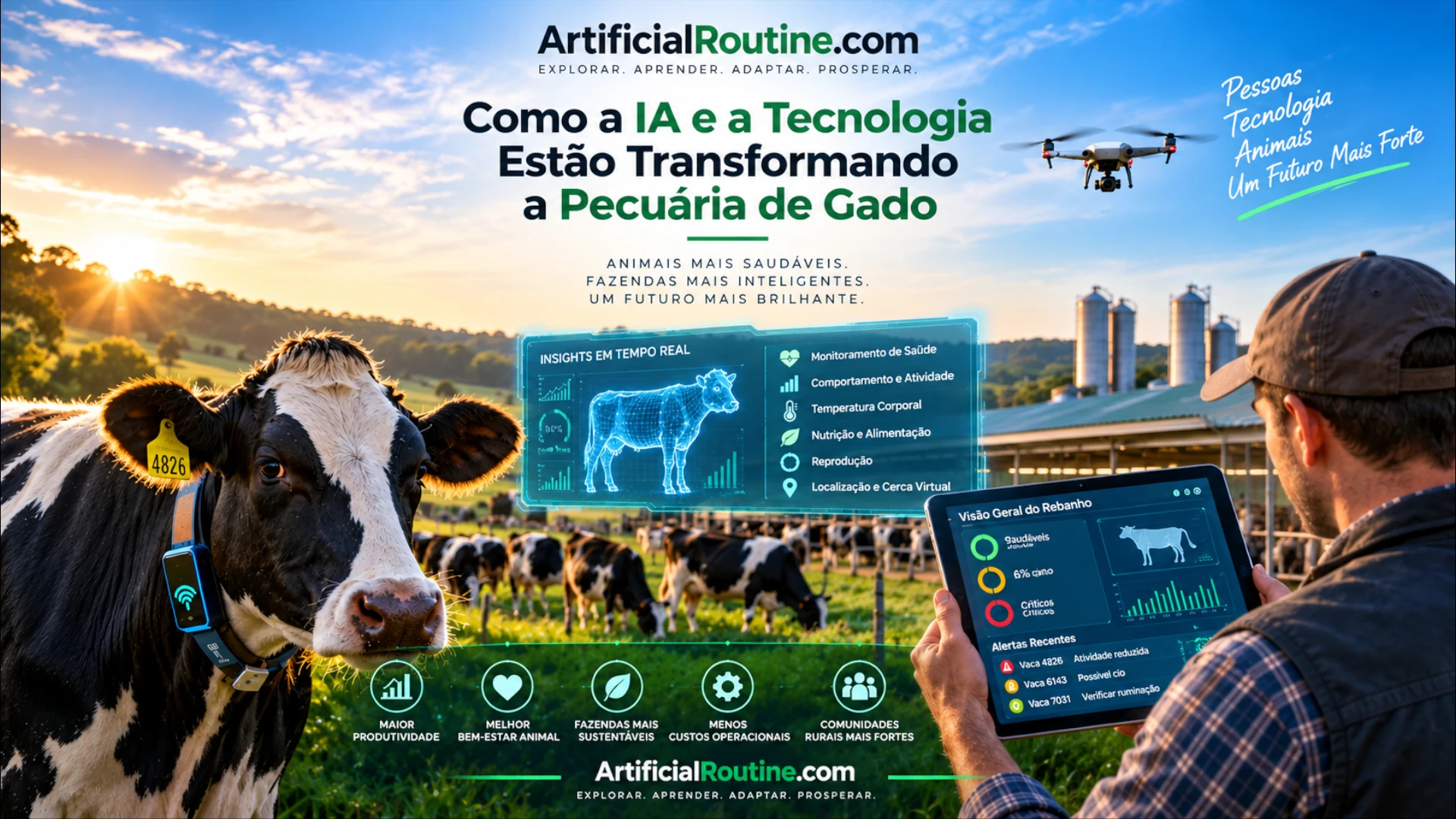
Artificial intelligence is often associated with chatbots, self-driving vehicles, robotics, and software development. But some of AI’s most consequential applications may be happening far away from technology companies—in barns, pastures, milking parlors, and cattle ranches.
Modern cattle farming is gradually becoming a data-driven operation.
Cows can wear connected collars that monitor their behavior. Cameras can observe animals without touching them. GPS systems can create virtual fences across thousands of acres. Sensors can continuously monitor milk production. Robotic systems can milk cows automatically, while software analyzes information about individual animals.
Artificial intelligence connects many of these technologies by turning enormous quantities of raw sensor data into information farmers can actually use.
This emerging field is generally known as Precision Livestock Farming (PLF).
The objective is not simply to automate farms or replace farmers. The more important goal is to give farmers something that historically has been extremely difficult to obtain:
continuous information about individual animals.
Instead of managing 500 cattle primarily as one herd, technology increasingly makes it possible to manage them as 500 individual animals.
And that changes almost everything.
What Is Precision Livestock Farming?
Precision Livestock Farming combines technologies such as:
- Artificial intelligence
- Machine learning
- Computer vision
- Internet of Things (IoT) sensors
- GPS
- Accelerometers
- RFID identification
- Thermal cameras
- Microphones
- Environmental sensors
- Automated feeding systems
- Robotic milking
- Cloud computing
- Farm-management software
to continuously collect and analyze information about livestock.
Penn State Extension describes modern dairy precision technologies as using devices including triaxial accelerometers, gyroscopes, positioning systems, infrared thermography, thermometers, and microphones to monitor reproduction, feeding behavior, and animal health.
A major 2024 scientific review examining 413 studies of precision cattle monitoring found that inertial sensors and image/video systems were among the most common technologies being investigated, while behavior and animal health were two of the leading applications.
The fundamental concept is surprisingly simple:
Measure → Analyze → Predict → Alert → Act → Learn
That cycle represents much of the future of intelligent cattle farming.
Step 1: Give Every Animal a Digital Identity
Before AI can understand an animal, the system needs to know which animal it is observing.
Traditionally, farmers have used numbered ear tags and other identification methods.
Modern farms can supplement those methods with technologies such as:
RFID ear tags
Radio-frequency identification allows equipment to electronically identify individual cattle.
Electronic collars
A collar can associate sensor measurements with a particular cow.
GPS devices
These provide both identification and location.
Computer vision
AI can potentially identify individual animals from camera images using physical characteristics and visual patterns.
Research into deep learning for cattle farming has already identified automated cattle identification as one of the major applications of the technology. A systematic review of 56 qualifying studies found that identification and health monitoring dominated the research examined.
Once the animal has a persistent digital identity, information collected throughout its life can become part of a continuously evolving record.
Imagine a digital profile containing:
- Date of birth
- Breed
- Genetics
- Weight history
- Feeding behavior
- Movement
- Rumination
- Vaccinations
- Medical history
- Reproductive history
- Pregnancy information
- Milk production
- Milk composition
- Body condition
- Location
- Behavioral abnormalities
The cow is no longer simply animal #247.
It becomes animal #247 plus years of searchable, measurable history.
Step 2: Sensors Become the Farmer’s Extra Eyes and Ears
A farmer walking through a herd is performing an extraordinarily complicated biological assessment.
Is that cow walking normally?
Is she eating?
Is she behaving differently?
Is she in heat?
Does she appear uncomfortable?
Is she chewing normally?
Has she separated herself from the herd?
Experienced farmers become extremely good at noticing these things.
The limitation is not human intelligence.
It is human availability.
A farmer cannot personally observe every animal every second of every day.
Sensors can.
For example, an accelerometer attached to a cow can measure patterns of movement throughout the day.
The system may distinguish behaviors such as:
- Walking
- Standing
- Lying down
- Eating
- Drinking
- Ruminating
- Resting
The interesting information isn’t necessarily any single measurement.
It is the change from normal behavior.
Suppose a cow normally ruminates for a predictable amount of time each day.
Suddenly her rumination declines substantially.
That doesn’t automatically mean she is sick.
But it is information worth investigating.
And this is where AI becomes extremely valuable.
Check out these other publications
 |  |
Step 3: AI Learns What “Normal” Looks Like
Sensors can produce millions of measurements.
Humans cannot realistically inspect all of them.
Artificial intelligence can.
A machine-learning system can establish behavioral baselines for individual animals and groups.
Instead of asking:
“Is this cow moving enough?”
the system can ask a much more useful question:
“Is this cow behaving differently from her normal pattern?”
That distinction matters.
One cow may naturally spend more time lying down than another. One animal may eat at slightly different times. Another may have a different normal rumination pattern.
AI makes individualized monitoring possible.
A 2026 review of computer vision in Precision Livestock Farming describes essentially this three-layer architecture:
- collecting data through sensors,
- analyzing those data using AI and machine learning,
- translating the results into decisions or interventions.
The review identifies applications including individual animal identification, body-condition estimation, lameness detection, calving prediction, and health monitoring.
This is an important conceptual change.
Traditional livestock management is often:
Human observes → Human interprets → Human acts
Precision livestock farming adds another layer:
Sensors observe → AI analyzes → System prioritizes → Human decides → Human or automation acts
AI becomes a filter between millions of observations and the farmer.
Step 4: Detect Potential Health Problems Earlier
One of the most promising applications of cattle-monitoring technology is early detection.
Animals cannot tell a farmer:
“Something feels wrong today.”
But their behavior may change before obvious clinical symptoms appear.
A sick cow may:
- eat less,
- ruminate less,
- walk differently,
- lie down more,
- isolate herself,
- produce less milk,
- drink differently,
- or exhibit temperature changes.
Individually, these signals can be difficult to interpret.
Together, they can form a recognizable pattern.
AI systems can continuously search for those patterns.
A real-world example is SenseHub Dairy, from Merck Animal Health.
The system continuously monitors animal behavior and provides farmers with information concerning reproduction, health, nutrition, and production.
Merck reports that SenseHub monitoring tracks rumination and activity and uses those changes to identify animals requiring attention. The company cites Cornell research involving more than 1,100 Holstein cows in which monitoring identified certain metabolic and digestive disorders with 93% accuracy and, in the studied circumstances, detected illness earlier than conventional observation.
This does not mean AI replaces a veterinarian.
A monitoring alert is not automatically a medical diagnosis.
In fact, Merck explicitly states that its monitoring product is not intended to diagnose, treat, cure, or prevent disease and recommends veterinary consultation for those purposes.
The better model is:
AI detects an anomaly → Farmer investigates → Veterinarian diagnoses when necessary → Treatment decision is made
That is augmented intelligence rather than autonomous medicine.
Step 5: AI Can Help Detect Lameness
Lameness is particularly interesting for computer vision.
A camera installed near a passageway can continuously observe cattle walking past.
Computer-vision software can analyze features such as:
- stride
- posture
- back position
- gait symmetry
- walking speed
- limb movement
Deep-learning systems can then look for patterns associated with abnormal locomotion.
This could eventually allow a farm to automatically identify an animal whose gait has begun changing—even when the change is subtle.
The advantage is scalability.
A camera doesn’t become tired after watching the 300th cow walk past.
Modern research into cattle computer vision includes not only locomotion but automated recognition of numerous behaviors. A 2026 review found rapid development involving convolutional neural networks, temporal models, pose estimation, 3D/spatiotemporal techniques, and Transformer-based architectures.
Step 6: AI Can Monitor Reproduction
Reproduction is another major economic component of cattle farming.
Determining when a cow is in estrus can influence breeding success.
Historically, farmers and employees have relied heavily on visual observation.
Connected monitoring systems can instead continuously analyze changes in activity and behavior.
The system can notify the farmer:
Cow 184 may be entering estrus.
More sophisticated software can help determine when insemination should occur.
Systems such as SenseHub already provide heat-detection and reproductive-monitoring capabilities based on continuous behavioral information.
Instead of employees repeatedly inspecting hundreds of animals looking for subtle behavioral signals, software can generate a prioritized list of animals requiring attention.
Step 7: Predict Calving
The same principle can potentially help farmers anticipate calving.
Before calving, cattle can exhibit changes in:
- activity
- feeding
- rumination
- posture
- isolation behavior
- lying/standing patterns
A sufficiently trained model can combine multiple signals and estimate whether an animal may be approaching calving.
This is another example where multimodal AI becomes particularly interesting.
Rather than depending upon one sensor, future systems can combine:
camera + collar + temperature + feeding + historical records + environmental data
The model isn’t analyzing one number.
It is interpreting the animal as a collection of interconnected biological signals.
Step 8: Computer Vision Can Watch the Herd
One of the most exciting developments in agricultural AI may be ordinary cameras.
Why?
Because cameras are non-contact sensors.
A cow doesn’t necessarily need another device attached to its body for every measurement.
A camera can potentially provide information about:
- animal identity
- location
- posture
- gait
- feeding
- drinking
- social behavior
- body condition
- movement
- abnormal behavior
Modern AI models can analyze images frame by frame and follow animals through video.
Research published in 2026 describes Precision Livestock Farming increasingly combining computer vision, IoT infrastructure, and AI for continuous individualized monitoring.
Computer vision also creates an interesting opportunity for existing farms.
Many farms already have security cameras.
In some situations, upgrading the intelligence behind existing camera infrastructure may ultimately be cheaper than attaching increasingly complex electronics to every animal.
The camera becomes a sensor.
The barn becomes a data environment.
Step 9: Thermal Imaging Can Add Another Layer
Normal cameras measure visible light.
Thermal cameras measure infrared radiation associated with surface temperature.
This creates additional possibilities.
Thermal imaging can potentially help monitor:
- inflammation
- temperature abnormalities
- heat stress
- udder conditions
- hoof conditions
- localized physiological changes
Again, AI can make the technology substantially more useful.
Instead of expecting someone to continuously examine thousands of thermal images, software can automatically flag unusual patterns.
The combination of RGB cameras, depth cameras, and thermal imaging could eventually create something approaching a continuous non-contact health-monitoring station.
Step 10: Smart Feeding
Feed represents one of the largest costs in cattle production.
Small improvements in feeding efficiency can therefore have substantial economic effects.
Technology can monitor:
- how frequently animals eat,
- how long they eat,
- feed consumption,
- rumination,
- weight,
- milk output,
- growth,
- environmental conditions,
- and feed composition.
AI can then help determine whether a feeding program is producing the expected outcome.
Instead of simply asking:
How much feed did the herd consume?
the farm can increasingly ask:
How is this ration affecting this group—or even this particular animal?
Connected feeding equipment can potentially dispense different amounts or formulations to different animals according to production stage, health, age, or nutritional requirements.
That is precision nutrition.
Step 11: Robotic Milking
Robotic milking is one of the clearest examples of agricultural automation moving from science fiction into everyday commercial farming.
In a voluntary robotic milking system, a cow can enter the milking station without a person manually attaching the equipment.
The system identifies the animal.
Computer vision and sensors locate the udder and teats.
The robot cleans and prepares the teats.
Robotic equipment attaches the milking cups.
Sensors monitor milk flow.
The system records production information.
The cow exits.
And the process repeats.
A commercial example is the DeLaval VMS V300.
DeLaval says its InSight technology combines cameras and software to perform automated attachment, while its InControl platform processes information collected during milking and presents it to farmers through reports and remote interfaces.
This means milking equipment is becoming more than machinery.
It is also an information system.
Each milking session creates another dataset about the cow.
Step 12: Milk Itself Becomes a Data Source
Milk contains valuable information.
Modern inline sensors can measure characteristics during milking rather than waiting exclusively for periodic external testing.
For example, SenseHub’s milk-monitoring platform can collect information including:
- milk yield
- lactose
- fat
- protein
- blood indicators
- conductivity
- somatic cell count
Its inline somatic-cell-count sensor can provide individual SCC information during the milking process.
Now combine that information with behavioral monitoring.
Imagine the system notices simultaneously:
Rumination ↓
Activity ↓
Milk production ↓
Milk conductivity changed
A single signal might mean little.
Multiple independent signals changing together can be much more informative.
This is where AI becomes increasingly powerful.
Step 13: GPS and Virtual Fencing
AI and connected technology are also changing cattle management outdoors.
Traditional grazing requires physical fences.
Building and maintaining those fences across thousands of acres can be expensive and labor intensive.
Virtual fencing introduces another possibility.
A commercial example is Vence, now part of Merck Animal Health.
Cattle wear GPS-enabled collars, while solar-powered base stations provide communications coverage. Farmers create virtual grazing boundaries through software rather than physically installing a fence at every boundary.
According to Merck, Vence base stations can cover approximately 5,000–10,000 acres depending upon terrain.
The farmer can digitally define where cattle should graze.
That means rotational grazing can become software configurable.
Instead of:
build fence → move cattle → remove or rebuild fence
the workflow can increasingly become:
open map → draw boundary → schedule movement → monitor cattle
This can also help farmers exclude environmentally sensitive areas or adjust grazing patterns.
Other commercial systems, including Halter, similarly combine connected collars, virtual boundaries, and software-based cattle movement.
Step 14: Drones Can Expand the Farmer’s View
Now consider a ranch covering thousands of acres.
Finding cattle manually can consume enormous amounts of time.
Drones equipped with:
- high-resolution cameras,
- thermal cameras,
- GPS,
- and computer vision
can potentially inspect large areas much faster.
AI could analyze aerial images to:
- count cattle,
- locate missing animals,
- identify isolated animals,
- inspect water sources,
- assess pasture conditions,
- detect damaged fencing,
- and locate potential hazards.
Eventually, autonomous drone missions could become part of routine ranch management.
A drone could fly a predetermined route every morning, while computer vision analyzes what it sees.
The farmer wouldn’t necessarily watch hours of video.
The system could simply report:
397 cattle located.
1 animal isolated from herd.
North water trough appears low.
Fence anomaly detected in sector 4.
That is the real value of AI: not generating more information for farmers to inspect, but reducing enormous amounts of information into a manageable list of things requiring human attention.
Step 15: AI Can Help Manage Heat Stress
Heat stress affects animal welfare, reproduction, feeding, and productivity.
Modern farms can install environmental sensors measuring:
- temperature
- humidity
- airflow
- solar radiation
- barn conditions
Those measurements can be combined with animal behavior.
For example:
Temperature rises → rumination declines → panting increases → milk output begins falling
Instead of waiting for the productivity loss to become obvious, an intelligent system could recognize the developing pattern.
Automated infrastructure could eventually respond by activating:
- fans,
- ventilation,
- sprinklers,
- cooling systems,
- shade systems.
SenseHub already provides herd-level monitoring that includes information related to heat stress, activity, and rumination.
This illustrates an important evolution:
Monitoring → Prediction → Automation
Step 16: The Digital Twin
Digital Twins: Creating a Virtual Cow and a Virtual Farm
One of the most exciting developments at the intersection of artificial intelligence, agriculture, and livestock management is the digital twin.
The term may sound futuristic, but the basic idea is surprisingly straightforward.
A digital twin is a continuously updated digital representation of something that exists in the physical world. In cattle farming, that “something” could be an individual cow, a group of cattle, a barn, a feeding system, or eventually an entire farm.
The important distinction is that a digital twin is not simply a 3D model of a cow.
A useful livestock digital twin receives information from the real animal and its environment—potentially including activity, feeding, rumination, milk production, temperature, location, reproductive information, and environmental conditions—and uses software models and AI to estimate what is happening now and what could happen next.
Researchers have already demonstrated AI-based cattle digital twins built from IoT sensor data. One peer-reviewed study developed a deep-learning digital twin capable of using sensor information to model cattle behavior and predict future behavioral states.
The long-term goal is powerful:
Instead of managing cattle primarily by reacting to visible problems, farmers could increasingly use continuously updated digital representations to anticipate problems before they become obvious.
How a Cattle Digital Twin Works
Think about a dairy cow named Cow 247.
Cow 247 exists physically in the barn. But the farm’s software could also maintain a continuously updated digital profile representing Cow 247.
That profile might contain:
- Identification and RFID information
- Age, breed, genetics, and lactation history
- Milk production
- Feeding behavior
- Rumination
- Walking and activity
- Lying and standing time
- Body temperature
- Reproductive status
- Health events
- Medication history
- Milking information
- Body condition
- Environmental exposure
- Historical behavior patterns
Not every farm will have all of these measurements, and not every digital-twin implementation requires them. The concept becomes more powerful as reliable data sources are connected.
The process can be understood as a continuous loop:
Physical Cow → Sensors → Data Platform → Digital Twin → AI Analysis → Prediction → Farmer/Veterinarian Decision → Physical Cow
Then the cycle begins again.
Step 1: Identify the Animal
The first requirement is knowing which animal generated which information.
RFID ear tags, electronic identification systems, collars, leg tags, computer vision, and other identification technologies can connect observations with an individual animal.
Instead of receiving a generic warning that “activity has decreased somewhere in the herd,” the system can potentially determine:
Cow 247 has experienced an unusual decline in activity compared with her normal behavior.
That distinction is critical.
AI becomes considerably more useful when it can learn an individual animal’s baseline rather than treating every cow identically.
Step 2: Collect Real-World Data
Sensors become the eyes and ears of the digital twin.
Wearable devices can use technologies such as accelerometers, GPS, RFID, microphones, and temperature sensing to monitor cattle behavior and health. Modern precision-livestock systems can collect information about activities such as walking, lying, feeding, and rumination.
Other information can come from equipment that many modern farms already operate.
For example, milking systems can produce information about milk yield, conductivity, milk flow, and other characteristics. Environmental sensors can measure temperature, humidity, gases, and barn conditions. Feeding systems can contribute information about diets and consumption.
The digital twin therefore does not necessarily require replacing a farm’s existing technology.
In many cases, the greater opportunity is connecting technologies that are already producing data.
Step 3: Bring the Data Together
This is one of the hardest—and most important—parts of the process.
A modern dairy farm may have valuable information spread across several systems:
RFID system → one database
Milking robot → another database
Activity collars → another platform
Feed-management software → another system
Veterinary records → another database
Barn sensors → another dashboard
Individually, each system can be valuable.
But AI becomes much more powerful when information can be combined.
For example, reduced milk production by itself could have many explanations.
Reduced milk production plus decreased rumination, reduced feed intake, abnormal activity, elevated temperature, and unusual milk measurements creates a much richer picture.
This is one reason data integration is becoming such an important part of agricultural AI.
Commercial platforms are already moving in this direction. Connecterra, for example, describes a dairy data platform designed to bring information from different farm systems together and apply AI-powered analysis and decision support.
Step 4: Build the Digital Representation
Once information has been collected and synchronized, software can maintain a continuously changing representation of each animal.
Imagine Cow 247’s digital profile at 6:00 a.m.:
Milk production: Normal
Rumination: Normal
Feed intake: Normal
Activity: Normal
Body temperature: Normal
Later that day:
Milk production: Slight decline
Rumination: 14% below individual baseline
Feed intake: Declining
Activity: 18% below baseline
Temperature: Increasing
Nothing dramatic may yet be visible to a person walking through the barn.
But the digital representation has changed.
This is where AI becomes particularly useful.
Step 5: AI Looks for Patterns
Machine-learning systems can compare the cow’s current state with several sources of information:
- Her historical behavior
- Recent changes
- Other animals in the herd
- Known disease patterns
- Reproductive cycles
- Environmental conditions
- Production information
Instead of relying on a single threshold, more advanced systems can evaluate combinations of variables.
For example:
Lower rumination + reduced feeding + lower activity + changing milk characteristics + increased temperature
may be much more significant than any individual measurement.
The AI can calculate whether the combination is unusual enough to deserve attention.
Research is increasingly investigating exactly this kind of multimodal approach. A 2024 study in Computers and Electronics in Agriculture, for example, combined video and sensor information to improve cow-behavior recognition specifically in the context of dairy-cow digital-twin modeling.
Step 6: Predict What May Happen Next
This is the point at which a digital twin becomes more than a monitoring dashboard.
Monitoring asks:
“What is happening to Cow 247?”
Predictive AI asks:
“What is likely to happen to Cow 247 next?”
The system could potentially estimate risks involving:
- Illness
- Mastitis
- Metabolic disorders
- Heat stress
- Reduced feed intake
- Reproductive events
- Changes in milk production
- Abnormal behavior
It is important to emphasize that these predictions are probabilities, not diagnoses.
A farmer or veterinarian should remain responsible for interpreting alerts and deciding what action is appropriate.
The goal of AI is not to replace the farmer’s experience or the veterinarian’s medical judgment. Its value is helping them determine which animal may need attention and when.
Step 7: Turn Prediction Into an Action
Imagine the system determines:
Cow 247 — elevated health-risk score.
Rather than simply displaying hundreds of graphs, a well-designed farm-management system should translate that analysis into something actionable:
Cow 247 requires attention.
Rumination and activity have declined significantly relative to her individual baseline while temperature is trending upward. Check animal.
The farmer can then inspect Cow 247.
If necessary, the animal can be examined by farm staff or a veterinarian.
This represents one of the biggest practical benefits of AI in cattle farming:
AI can help farmers decide where to direct limited human attention.
On a farm with 1,000 cows, checking every animal’s sensor graphs every morning would be impractical.
Having the system identify the 10 animals exhibiting the most unusual patterns is much more useful.
Digital Twins Can Extend Beyond the Individual Cow
The same principle can eventually operate at multiple levels.
A farm could maintain digital representations of:
Individual animal → Pen → Herd → Barn → Feeding system → Milking operation → Entire farm
Consider heat stress.
Environmental sensors detect increasing temperature and humidity.
Activity sensors detect behavioral changes.
Milk-production data begins showing a decline.
Water consumption changes.
The digital farm model recognizes the relationship among those signals and predicts that a particular group of cattle is at increasing risk of heat stress.
The system could recommend:
Increase ventilation in Barn 2.
More advanced implementations could potentially connect decision-support systems with automated ventilation, cooling, feeding, or other farm infrastructure—with appropriate safeguards and human oversight.
That creates a feedback loop:
Sense → Understand → Predict → Decide → Act → Measure Result → Learn
This is one of the fundamental ideas behind the smart farm.
A Real-World Example: SRUC’s Farm-Twin
Digital twins for agriculture are not merely theoretical.
Scotland’s Rural College (SRUC) announced an open-source dairy digital-twin platform called farm-twin, developed through its Dairy Research Centre with funding connected to the UKRI-backed Digital Dairy Chain.
According to SRUC, the platform can integrate data streams from different vendors and display them through common dashboards. It is also designed to support predictive analytics for identifying health or productivity problems earlier.
This is important because one of the biggest obstacles to agricultural digital twins is not necessarily creating another sensor.
It is getting existing systems to communicate.
A farmer may already possess much of the necessary infrastructure. The missing component may be the digital layer capable of connecting and interpreting it.
Existing Technology Is Already Providing Pieces of the Digital Twin
Some commercially available agricultural technologies should not necessarily be described as complete digital twins, but they already perform important parts of the digital-twin process.
A good example is DeLaval and its Herd Navigator system.
Herd Navigator automatically analyzes milk and uses biomarkers to support reproductive and health management. DeLaval says its system uses progesterone for reproductive monitoring, lactate dehydrogenase for udder-health monitoring, beta-hydroxybutyrate for ketosis detection, and urea information for feeding management. Its BioModels transform these measurements into recommendations and alerts for individual cows.
This illustrates an important point.
The transition toward digital twins will probably not happen because farmers suddenly discard all their existing equipment and purchase an entirely new “digital-twin farm.”
It can happen incrementally.
A farm might start with:
Electronic identification
Then add:
Activity monitoring
Then:
Automated milking data
Then:
Environmental sensors
Then:
Computer vision
Then:
Integrated data storage
And finally:
AI models connecting those systems and predicting future conditions.
Digital transformation in agriculture can therefore be evolutionary rather than revolutionary.
Computer Vision Could Make Digital Twins Even More Powerful
Cameras are another potentially important source of information.
Computer vision allows AI to analyze video and identify animals, track movement, recognize behaviors, and potentially detect physical or behavioral abnormalities.
Recent research demonstrates how quickly this area is developing.
A 2026 study published in npj Veterinary Science developed a video-based system for dairy cattle capable of identifying individual cows and classifying seven behaviors under commercial barn conditions. The researchers combined YOLOv11 object detection, ByteTrack tracking, and video-behavior recognition models, producing structured information that could feed downstream digital-twin systems.
This matters because cameras can provide something wearable sensors cannot always capture easily:
context.
A collar might detect movement.
A camera may help determine what that movement represents.
Combining both creates a richer representation of the animal.
The Future: Asking “What If?” Before Changing the Farm
Perhaps the most interesting future application of digital twins is simulation.
Once a digital twin accurately represents a farm, farmers may eventually be able to test management decisions digitally before implementing them physically.
For example:
What happens if we change this feed ration?
What happens if summer temperatures increase by 5°F?
What happens if we move this group into another barn?
What happens if we alter milking frequency?
What happens if feed prices rise?
What happens if we install additional cooling?
The digital model could simulate likely consequences involving production, animal health, resource consumption, economics, and potentially environmental impact.
This is particularly relevant to dairy nutrition. A 2025 systematic review examining 122 peer-reviewed studies described how sensor-enabled digital twins can combine real-time farm information with computational models for precision dairy nutrition. The researchers also identified hybrid edge-and-cloud computing as an important architecture for future systems.
Instead of:
Make a change → wait → discover whether it worked
the future workflow could increasingly become:
Simulate → compare scenarios → choose → implement → measure → improve the model
But Digital Twins Are Not Magic
There is an important reality check.
A digital twin is only as useful as the information and models behind it.
Bad sensor data can produce bad conclusions.
Missing information can produce incomplete models.
A model trained on one farm may not perform equally well on another farm with different breeds, climates, housing systems, diets, equipment, or management practices.
Connectivity is another challenge, particularly in rural areas.
Interoperability between equipment manufacturers remains an important issue.
Farmers must also consider data ownership, cybersecurity, privacy, system reliability, maintenance costs, and what happens when an automated system fails.
Most importantly, a digital twin should not become an excuse to remove human observation from animal husbandry.
The strongest model is likely:
Farmer experience + veterinary expertise + sensors + AI + automation
rather than:
AI instead of farmers.
From Precision Farming to Predictive Farming
For decades, agricultural technology has helped farmers measure what happened.
The next generation of systems is increasingly helping them understand what is happening right now.
Digital twins could take the industry another step forward by helping predict what is likely to happen next.
That progression can be summarized simply:
Traditional farming:
“What do I see?”
Precision farming:
“What does the data show?”
AI-assisted farming:
“What does the data mean?”
Predictive farming:
“What is likely to happen next?”
Digital-twin farming:
“What is likely to happen next—and what could happen if I make a different decision?”
That final question may ultimately be one of AI’s most valuable contributions to cattle farming.
The future farm will still have fences, barns, tractors, feed, cattle, veterinarians, and—most importantly—farmers.
But alongside the physical farm may increasingly exist another farm:
a continuously updated digital version that never sleeps, constantly learns from the real world, and helps the people running the farm make better decisions.
That is the promise of the agricultural digital twin.
Credible References and Further Reading
1. Penn State Extension — Precision Livestock Farming: Dairy Technologies
Full URL: https://extension.psu.edu/precision-livestock-farming-dairy-technologies
Penn State Extension provides an excellent practical explanation of Precision Livestock Farming and how sensors are already being used on dairy farms. The resource discusses accelerometers, gyroscopes, positioning technologies, infrared thermography, temperature sensors, microphones, RFID, rumination monitoring, milk monitoring, estrus detection, and early identification of animals that may require examination. It also explains how sensor data are transferred to software where algorithms establish behavioral baselines and generate alerts when individual cows deviate from their normal patterns. This is an especially strong reference for the sections of this article covering wearable sensors, health monitoring, reproduction, and individualized animal monitoring.
2. Smart Agricultural Technology / Elsevier — Scoping Review of Precision Technologies for Cattle Monitoring
Full URL: https://www.sciencedirect.com/science/article/pii/S2772375524002016
This 2024 peer-reviewed scientific review examined 413 studies involving precision technologies for cattle monitoring. Researchers found that inertial sensors and image/video technologies were among the most widely studied approaches, while animal behavior and health monitoring represented major applications. The paper also documents the growing role of machine learning in cattle monitoring. Because it synthesizes hundreds of scientific studies rather than describing a single product, it provides strong academic support for the broader discussion of AI, sensors, computer vision, and Precision Livestock Farming in this article.
3. ScienceDirect / Computers and Electronics in Agriculture — A Systematic Literature Review on Deep Learning Applications for Precision Cattle Farming
Full URL: https://www.sciencedirect.com/science/article/pii/S0168169921003306
This peer-reviewed systematic review examines the application of deep learning specifically to cattle farming. The researchers initially identified 678 studies and selected 56 that met their review criteria. Two major areas emerged: individual cattle identification and health monitoring. The study discusses technologies and AI architectures including convolutional neural networks (CNNs), LSTM models, Mask R-CNN, Faster R-CNN, and ResNet. This provides scientific support for the article’s discussion of computer vision, automatic animal identification, behavioral analysis, and AI-assisted health monitoring.
4. Scotland’s Rural College (SRUC) — World’s First Open-Source Digital Twin for Dairy Farming
Full URL: https://www.sruc.ac.uk/all-news/sruc-launches-world-s-first-open-source-digital-twin-for-dairy-farming/
Scotland’s Rural College provides a real-world example of the digital-twin concept applied to dairy farming. SRUC’s Dairy Research Centre developed farm-twin, an open-source platform designed to create a digital representation of a farm using real-time information from sensors, telemetry, and other digital technologies. Importantly, the platform is designed to integrate data from multiple vendors and support predictive analytics that can help identify health or productivity problems earlier. This source directly supports the Digital Twin section of this article.
5. DeLaval — VMS V300 Robotic Milking System and AI-Assisted Vision Technology
Full URL: https://www.delaval.com/en-us/farm-solutions/milking/delaval-vms-series/delaval-vms-milking-system-v300/
DeLaval provides a commercial, real-world example of sophisticated automation already operating in dairy farming. Its VMS V300 robotic milking platform uses DeLaval InSight, which combines camera technology and software for automated teat location and attachment. The system also collects large quantities of information from individual cows during milking. DeLaval’s InControl software processes those data and provides farmers with reports and operational information. This is a useful real-world reference demonstrating that robotic milking, computer vision, individualized cow data collection, and automated farm-management technologies are already commercially deployed—not merely experimental concepts.