
 BitFlip27
Beyond Earth: The Race to Build AI Data Centers Under the Ocean, In Space, and on the Moon
ArtificialRoutine.com
How artificial intelligence is pushing humanity toward an entirely new era of computing infrastructure.
Introduction
Artificial Intelligence is transforming nearly every aspect of modern life. Every conversation with ChatGPT, every image generated by AI, every autonomous vehicle, medical diagnosis, financial prediction, and scientific simulation depends on one thing:
Computing power.
Behind every AI model lies an enormous network of servers housed inside data centers. These facilities consume staggering amounts of electricity, require sophisticated cooling systems, and occupy vast amounts of land.
Until recently, the world’s largest technology companies competed by building bigger and more efficient data centers on Earth. Today, however, a new idea is gaining momentum:
What if the future of computing isn’t on Earth at all?
Around the world, governments, startups, and some of the world’s most influential entrepreneurs—including Elon Musk, Jeff Bezos, and major technology companies like Microsoft—are exploring ways to move computing infrastructure into environments once considered impossible.
Some experiments have already taken place beneath the ocean.
Others are being designed for Earth orbit.
A few companies are even preparing for permanent data storage—and eventually computing—on the Moon.
While many of these projects remain experimental, they reveal a remarkable truth:
The next generation of AI infrastructure may extend far beyond our planet.
Check Out These Articles
 |  |
The Hidden Journey of Every Prompt | The AI Behind Social Media |
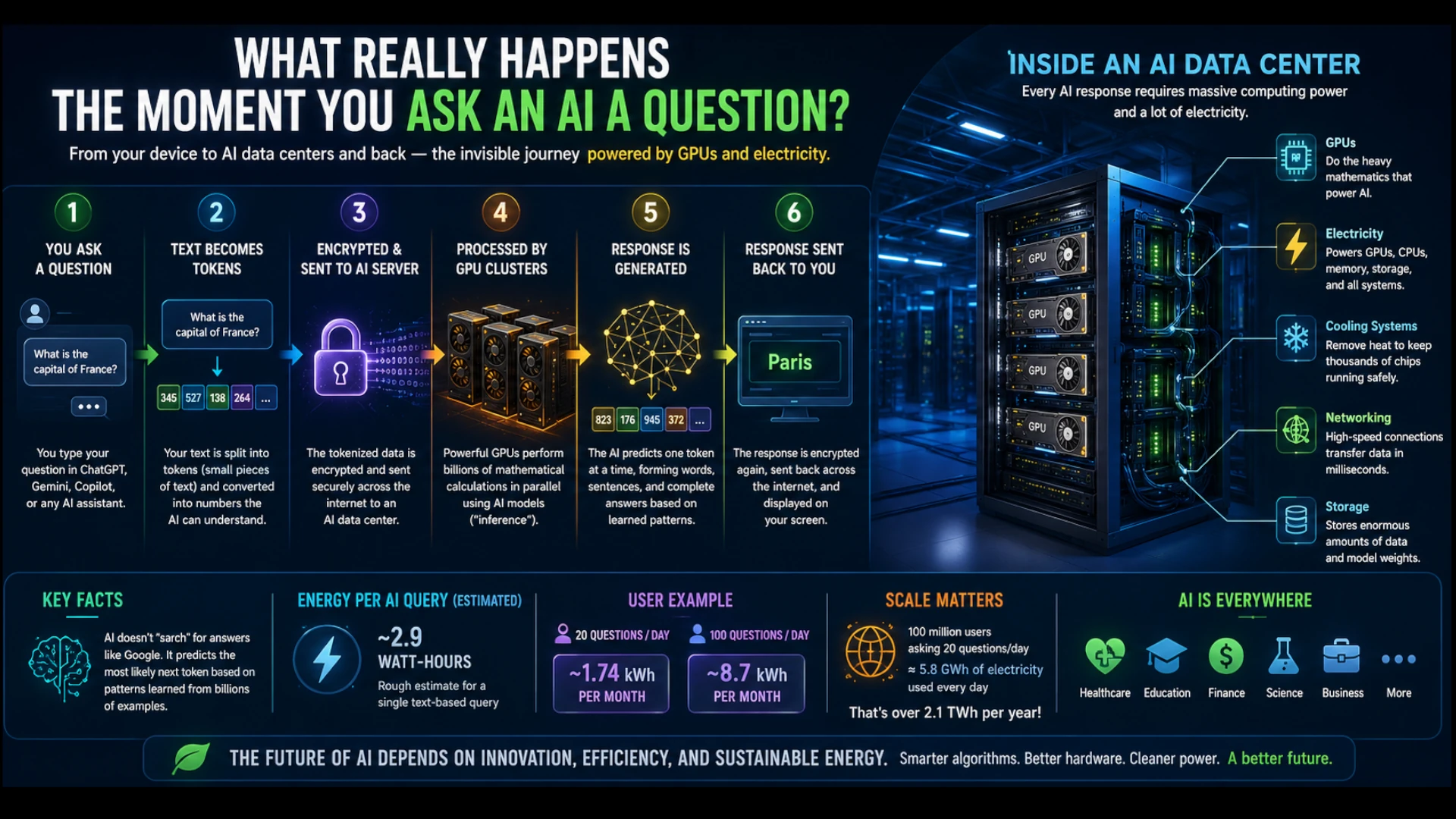
Why AI Needs So Much Computing Power
Artificial intelligence has changed the economics of computing.
Training modern large language models requires tens of thousands—and increasingly hundreds of thousands—of advanced GPUs operating continuously for months.
After training, those models must answer millions—or billions—of user requests every day.
This creates an enormous demand for:
- Electricity
- Cooling
- Networking
- Storage
- High-performance processors
- Reliable infrastructure
According to estimates from the International Energy Agency (IEA), electricity consumption from data centers is expected to rise significantly over the coming decade as AI adoption accelerates.
Traditional cloud providers—including Microsoft, Google, Amazon, Oracle, and Meta—are investing hundreds of billions of dollars in new AI infrastructure.
But simply building more data centers on Earth introduces new challenges.
The Data Center Problem
Modern AI facilities consume extraordinary resources.
Some of today’s largest AI campuses require:
- Hundreds of megawatts of electricity
- Millions of gallons of cooling water
- Acres of valuable land
- Massive electrical transmission infrastructure
As AI demand grows, engineers face difficult questions:
- Where will all this electricity come from?
- How do we cool increasingly powerful processors?
- How do we reduce environmental impact?
- Can computing move closer to where data is generated?
These questions have inspired some surprisingly creative solutions.
Microsoft’s Underwater Data Center Experiment
One of the most fascinating experiments came from Microsoft.
The project, known as Project Natick, investigated whether data centers could operate on the ocean floor.
Instead of cooling thousands of servers using expensive industrial cooling systems, Microsoft placed an entire sealed data center inside a pressure-resistant steel cylinder and lowered it to the seabed near Scotland.
The ocean itself became the cooling system.
Why underwater?
The advantages were compelling:
- Constant cold temperatures
- No exposure to weather
- Minimal human interference
- Reduced cooling energy
- Faster deployment near coastal population centers
After operating for approximately two years, Microsoft recovered the underwater data center and discovered something remarkable.
The hardware experienced a significantly lower failure rate than comparable land-based servers.
The sealed environment eliminated dust, humidity fluctuations, and accidental human contact—three common causes of hardware failure.
Although Microsoft has not commercialized Project Natick, the experiment demonstrated that unconventional computing environments can be both practical and highly reliable.
If Underwater Works… Why Not Space?
Once engineers began questioning traditional assumptions, another idea naturally emerged.
Space offers several unique advantages unavailable on Earth.
Imagine data centers that receive uninterrupted sunlight for solar power, communicate through laser links, and process satellite data without sending enormous amounts of raw information back to Earth.
Instead of downloading terabytes of satellite imagery every day, an orbital AI system could analyze the images directly in space and transmit only the final results.
This concept is becoming known as orbital edge computing.
Potential applications include:
- Weather forecasting
- Disaster response
- Military intelligence
- Environmental monitoring
- Space exploration
- Climate research
Processing data closer to where it is collected can dramatically reduce communication delays and bandwidth requirements.
The New Space Race for AI Infrastructure
During the last decade, launch costs have fallen dramatically thanks to reusable rockets.
This change is making concepts that once seemed impossible worthy of serious engineering studies.
Several organizations are now investigating orbital computing platforms.
Instead of launching individual satellites that perform limited functions, future spacecraft could become complete data centers equipped with AI accelerators, storage, optical networking, and autonomous operations.
These orbital facilities could eventually work together as distributed computing clusters.
In effect, the cloud itself would extend into space.
Elon Musk, SpaceX, and Orbital AI
No discussion of space infrastructure would be complete without Elon Musk.
Through SpaceX, Musk has already transformed satellite communications with the Starlink constellation.
With thousands of satellites already operating and many more planned, SpaceX has demonstrated that launching and maintaining large constellations is technically feasible.
As AI demand continues to grow, industry observers have proposed an even more ambitious concept:
Massive constellations of orbital computing satellites.
Some public proposals and media reports have described future architectures involving up to one million specialized orbital AI-computing satellites.
It is important to distinguish between engineering concepts and confirmed deployment plans.
As of today, SpaceX has not officially announced a program to deploy one million operational AI data-center satellites.
However, the broader vision—using orbit as a location for large-scale computing infrastructure—is receiving increasing attention throughout the aerospace and AI industries.
If launch costs continue to decline through Starship and future reusable launch systems, orbital computing could become economically viable for specialized workloads.
Why Space Is Attractive for Computing
At first glance, placing computers in orbit seems impractical.
Surprisingly, space offers several compelling advantages.
Nearly Unlimited Solar Energy
Outside Earth’s atmosphere, solar panels receive consistent sunlight without clouds or weather.
This enables continuous renewable power generation for many orbital configurations.
Processing Data in Orbit
Earth observation satellites generate enormous amounts of information.
Instead of transmitting every image to Earth, onboard AI could identify:
- Wildfires
- Floods
- Crop diseases
- Military movements
- Illegal fishing
- Oil spills
Only the important information would be transmitted, saving bandwidth and reducing response times.
Global Connectivity
Future orbital data centers could communicate using high-speed optical laser links.
This technology promises lower latency and higher bandwidth than many traditional radio systems.
The Biggest Challenge: Heat
Ironically, one of the biggest engineering problems in space is not keeping computers warm—it is keeping them cool.
On Earth, cooling is relatively simple.
Fans move air.
Water absorbs heat.
Cooling towers dissipate energy into the atmosphere.
Space has no atmosphere.
No air.
No wind.
No convection.
Heat can leave only through thermal radiation.
That means orbital data centers require enormous radiator panels to reject waste heat into space.
Managing heat efficiently may become the single greatest engineering challenge for orbital AI infrastructure.
Could the Moon Become the World’s Safest Data Vault?
The Moon has become the next frontier in digital infrastructure.
One of the companies leading this effort is Lonestar, which is developing lunar data storage services.
The company’s vision is straightforward:
Store humanity’s most valuable digital information somewhere extraordinarily secure.
The Moon offers several advantages:
- Geologically stable
- No earthquakes
- No floods
- No hurricanes
- No political borders
- Excellent conditions for long-term archival storage
Initially, these missions focus on preserving critical data.
In the future, researchers envision expanding beyond storage toward scientific computing and specialized lunar computing facilities.
Could the Moon Host AI Data Centers?
Although no one is currently building massive AI data centers on the Moon, researchers have begun exploring what such facilities might look like in the future.
Potential advantages include:
- Vast open areas for solar arrays
- Stable geological environment
- Natural vacuum for certain industrial processes
- Long-term support for lunar exploration
Future lunar industries could include:
- Scientific computing
- Astronomical data processing
- Mission control support
- Deep-space communications
- AI systems supporting Moon and Mars missions
Before this becomes reality, enormous engineering challenges must be solved, including radiation protection, lunar dust mitigation, energy storage during the two-week lunar night, and construction using local materials.
Jeff Bezos and the Vision of Millions Living and Working in Space
Jeff Bezos has long argued that heavy industry and large-scale infrastructure will eventually move off Earth.
Through Blue Origin, he envisions a future where millions of people live and work in space, preserving Earth primarily for residential life and nature.
While Blue Origin has not announced plans for orbital AI data centers comparable to current space-computing proposals, the company’s long-term vision aligns with the broader trend of moving industrial-scale activities beyond Earth’s surface.
As launch systems improve, space-based computing could become one component of that future economy.
Other Companies Exploring the Future
Several organizations are investigating pieces of this technological puzzle.
These include:
- Microsoft (underwater infrastructure)
- Google (AI-optimized data centers)
- Amazon Web Services
- SpaceX
- Blue Origin
- Lonestar
- NASA research programs
- European Space Agency initiatives
- Multiple startups developing orbital computing technologies
Each organization approaches the challenge differently, but they all recognize the same underlying reality:
The age of AI requires infrastructure unlike anything humanity has ever built.
The Challenges Ahead
The vision is exciting, but reality remains difficult.
Major obstacles include:
Launch Costs
Even with reusable rockets, placing thousands of tons of computing equipment into orbit remains extraordinarily expensive.
Radiation
Space exposes electronics to high-energy particles capable of damaging processors and memory.
Maintenance
Replacing failed hardware hundreds—or thousands—of kilometers above Earth is far more difficult than servicing a terrestrial data center.
Space Debris
Large orbital infrastructures must avoid collisions with existing satellites and debris.
Economics
Building space-based computing must ultimately prove less expensive—or more valuable—than expanding infrastructure on Earth.
Will AI Data Centers Really Leave Earth?
The most likely future is not one where every data center moves into space.
Instead, experts envision a hybrid computing ecosystem.
Different environments may specialize in different tasks.
Earth
General cloud computing, enterprise services, and consumer AI.
Underwater
Energy-efficient regional facilities requiring minimal cooling.
Orbit
Satellite data processing, Earth observation, communications, and specialized AI workloads.
Moon
Long-term archival storage, scientific computing, and infrastructure supporting future lunar exploration.
Rather than replacing terrestrial computing, these systems may complement it.
Looking Toward the Next Frontier
History shows that humanity continually pushes infrastructure toward new frontiers.
Factories transformed manufacturing.
Power plants transformed industry.
Fiber optics transformed communication.
Cloud computing transformed software.
Artificial intelligence is now transforming the infrastructure beneath everything else.
What once sounded like science fiction—data centers beneath the ocean, autonomous computing satellites, and digital archives on the Moon—is increasingly becoming the subject of serious engineering.
Some of today’s proposals may never move beyond prototypes.
Others may become as commonplace tomorrow as cloud computing is today.
The next great technological revolution may not simply be smarter artificial intelligence.
It may be where that intelligence lives.
And for the first time in human history, the answer may no longer be Earth.
Final Thoughts
Artificial intelligence is forcing humanity to rethink the physical limits of computing. Every breakthrough in AI increases the demand for faster processors, cleaner energy, better cooling, and more resilient infrastructure. While terrestrial data centers will remain the backbone of the digital world for decades, underwater facilities, orbital computing platforms, and lunar infrastructure demonstrate that innovation is no longer confined to conventional thinking.
Whether these ambitious visions ultimately become global industries or remain extraordinary engineering experiments, they share a common goal: enabling the next generation of scientific discovery, communication, and artificial intelligence.
One thing is becoming increasingly clear—the future of computing is not just about building more powerful computers. It is about discovering entirely new places for them to exist.
References
Official Organizations
International Energy Agency (IEA)
Key Questions on Energy and AI
https://www.iea.org/reports/key-questions-on-energy-and-ai
Executive Summary
https://www.iea.org/reports/key-questions-on-energy-and-ai/executive-summary
Microsoft Research – Project Natick
Official Project Natick page
https://www.microsoft.com/en-us/research/project/natick/
Project Natick timeline and technical information
https://natick.azurewebsites.net/
Microsoft News – Underwater Data Center
https://news.microsoft.com/features/under-the-sea-microsoft-tests-a-datacenter-thats-quick-to-deploy-could-provide-internet-connectivity-for-years/
Microsoft Azure Infrastructure – Project Natick
https://datacenters.microsoft.com/globe/innovating-your-future/
NASA
NASA Artemis Program
https://www.nasa.gov/artemis/
NASA Moon to Mars Program
https://www.nasa.gov/humans-in-space/moon-to-mars/
NASA Lunar Exploration
https://science.nasa.gov/moon/
European Space Agency (ESA)
ESA Homepage
https://www.esa.int/
ESA Space Safety
https://www.esa.int/Safety_Security
Lonestar Data Holdings
Official Website
https://www.lonestar.space/
Mission Information
https://www.lonestar.space/mission
Government Publications
U.S. Government Accountability Office (GAO)
Science & Technology Spotlight:
Data Centers in Space
https://www.gao.gov/products/gao-26-109012
Direct PDF
https://www.gao.gov/assets/890/885431.pdf
Research Papers
Deep Tech to Space: Space Data Centers and AI Revolution at the Edge
https://arxiv.org/abs/2605.19892
From Connectivity to Multi-Orbit Intelligence:
Space-Based Data Center Architectures for 6G and Beyond
https://arxiv.org/abs/2603.18601
Tether-Based Architecture for Solar-Powered Orbital AI Data Centers
https://arxiv.org/abs/2512.09044
Additional Reading
Microsoft Research:
Post-Quantum Crypto Tunnel to the Underwater Datacenter
Sources and Further reading.
- International Energy Agency (IEA). Key Questions on Energy and AI — https://www.iea.org/reports/key-questions-on-energy-and-ai
- Microsoft Research. Project Natick — https://www.microsoft.com/en-us/research/project/natick/
- Microsoft News. Under the Sea: Project Natick — https://news.microsoft.com/features/under-the-sea-microsoft-tests-a-datacenter-thats-quick-to-deploy-could-provide-internet-connectivity-for-years/
- U.S. Government Accountability Office. Science & Tech Spotlight: Data Centers in Space — https://www.gao.gov/products/gao-26-109012
- NASA. Artemis Program — https://www.nasa.gov/artemis/
- NASA. Moon to Mars — https://www.nasa.gov/humans-in-space/moon-to-mars/
- European Space Agency — https://www.esa.int/
- Lonestar Data Holdings — https://www.lonestar.space/
- Reuters. SpaceX’s orbital data centers could face same hurdles as Microsoft’s abandoned undersea project — https://www.reuters.com/business/aerospace-defense/spacexs-orbital-data-centers-could-face-same-hurdles-microsofts-abandoned-2026-04-01/
- Weiss et al. Deep Tech to Space: Space Data Centers and AI Revolution at the Edge — https://arxiv.org/abs/2605.19892