BitFlip27
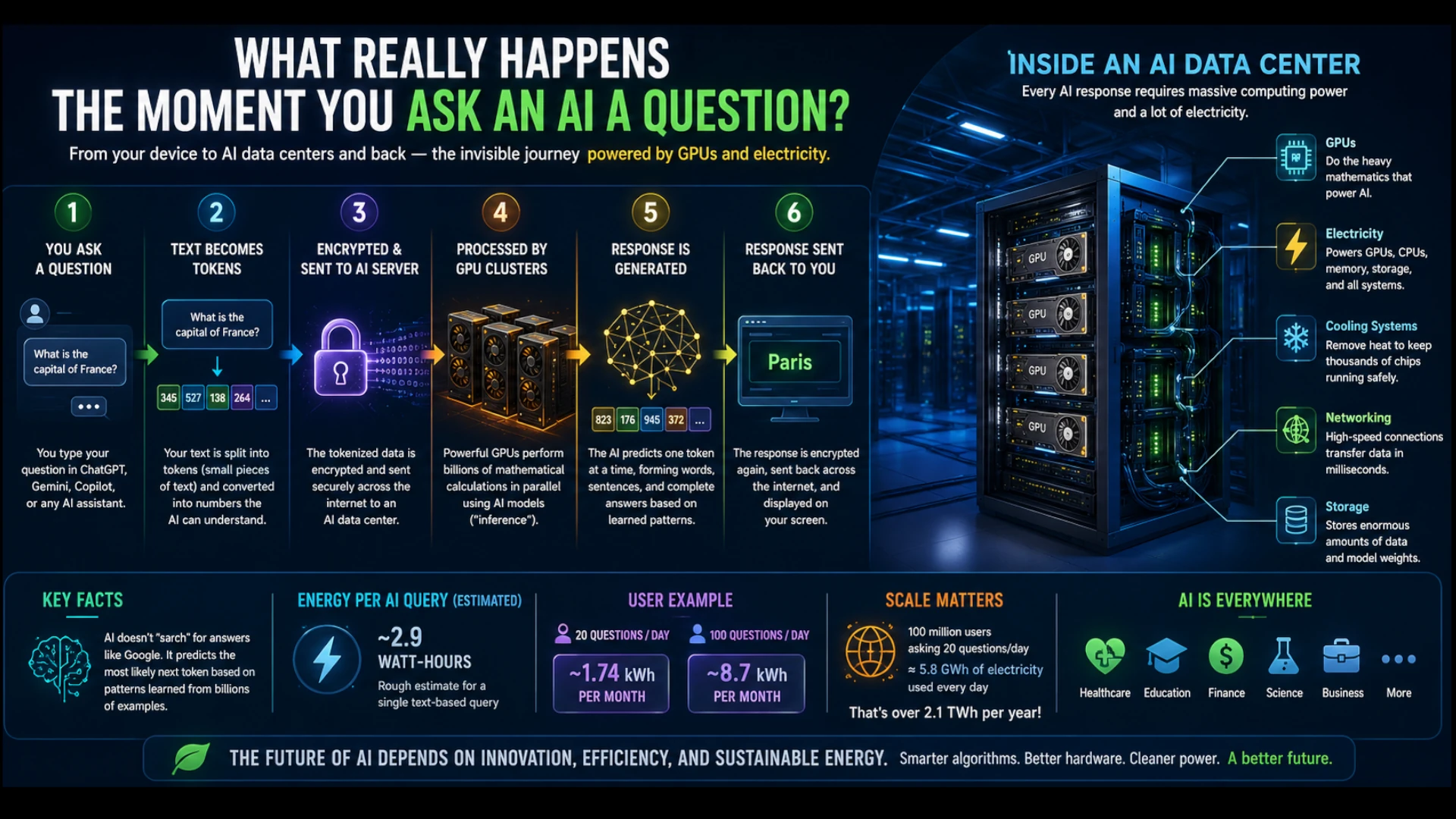
What Really Happens the Moment You Ask an AI a Question? The Hidden Journey of Every Prompt and the Electricity Powering Artificial Intelligence
By ArtificialRoutine.com
Every AI Conversation Begins with a Single Question
It is 8:00 in the morning.
You sit down with a cup of coffee, open ChatGPT, Gemini, Copilot, Claude, or another artificial intelligence assistant, and type a simple question:
“What is the tallest mountain in the world?”
You press Enter.
Less than two seconds later, a detailed answer appears on your screen.
To you, it feels almost effortless. It seems as though the AI simply “knew” the answer and responded instantly.
But behind those few seconds lies one of the most sophisticated technological processes ever created by humanity.
The moment you press Enter, your computer, the Internet, cloud networking, massive AI data centers, thousands of specialized processors, and billions—sometimes trillions—of mathematical calculations begin working together to generate a response.
Almost everything happens invisibly.
Most people never think about what occurs between asking a question and receiving an answer.
Yet understanding that invisible journey reveals something extraordinary: every AI conversation depends on an enormous global infrastructure powered by advanced computing and vast amounts of electricity.
Artificial intelligence isn’t magic.
It is mathematics, engineering, computer science, networking, and energy working together on an unprecedented scale.
Let’s follow the complete journey of your question.
Step 1: You Type a Question
When you type:
“What is the tallest mountain in the world?”
your computer displays ordinary English words.
However, AI models cannot understand human language directly.
Unlike people, AI does not “read” words.
Instead, it processes numbers.
Before your question can be understood, it must first be converted into a numerical language that the model can process.
This process is called tokenization.
Check these Publications
 |  |
Step 2: Your Sentence Becomes Tokens
One of the biggest misconceptions about artificial intelligence is that it understands complete words and sentences exactly as humans do.
It doesn’t.
Instead, every prompt is broken into much smaller pieces called tokens.
A token is a unit of text that an AI model uses internally.
Sometimes a token is an entire word.
Sometimes it is only part of a word.
Sometimes punctuation marks become individual tokens.
Even spaces, numbers, and symbols may be represented as tokens.
For example:
The word
Cat
may become one token.
A longer word like
Artificial
might become two or more tokens depending on the tokenizer.
The sentence
“Artificial intelligence is amazing.”
could become something similar to:
- Artificial
- intelligence
- is
- amazing
- .
Each of these pieces receives its own numerical identifier.
The AI never actually sees the letters.
Instead, it receives something conceptually similar to:
14823
29571
102
8844
13
These numbers become the language of artificial intelligence.
Everything the AI processes—from Shakespeare to computer programming—is represented as numerical tokens.
Why Tokens Matter
Every AI model has a limit on how many tokens it can process at one time.
This is known as its context window.
The larger the context window, the more information the AI can remember during a conversation.
That is why longer documents require more computing power.
A short prompt may contain only 20 tokens.
A programming project might contain 50,000 tokens.
A complete book could contain hundreds of thousands of tokens.
The more tokens processed, the more mathematical calculations must be performed.
Step 3: Your Prompt Is Encrypted
Once tokenization finishes, your prompt is prepared for transmission.
Security now becomes extremely important.
Your question is encrypted before it leaves your device.
Encryption transforms the information into unreadable data that can only be decoded by the intended destination.
Think of it like sealing a letter inside a locked metal box before placing it in the mail.
Even if someone intercepted the box, they would not be able to read the contents without the proper key.
Modern AI services use secure Internet protocols to protect your data while it travels across networks.
Millions of encrypted requests are moving across the Internet every second.
Your prompt becomes one of them.
Step 4: Your Prompt Travels Across the Internet
Now your encrypted data begins an incredible journey.
Within milliseconds, your request travels through multiple layers of networking infrastructure.
It may pass through:
- Your Wi-Fi router
- Your Internet Service Provider
- Regional Internet exchanges
- Fiber-optic backbone networks
- International communication links
- Cloud networking infrastructure
Light travels through fiber-optic cables at roughly two-thirds the speed of light in a vacuum.
Your request may travel hundreds or even thousands of miles before reaching the AI provider’s nearest data center.
Despite the enormous distance, the entire trip often takes less than one tenth of a second.
Modern networking is one of humanity’s greatest engineering achievements.
Without it, cloud-based artificial intelligence would not exist.
Step 5: Your Question Arrives at an AI Data Center
Eventually, your encrypted request reaches a massive AI data center.
Forget everything you imagine when you hear the word “computer.”
This is not a desktop PC.
An AI data center is an industrial-scale computing facility.
Many are as large as football stadiums.
Inside are endless rows of server racks stretching across enormous buildings.
Thousands upon thousands of computers operate continuously.
Every machine is connected through ultra-fast networking capable of moving enormous amounts of data every second.
Specialized cooling systems constantly remove heat.
Redundant power systems ensure that nothing stops running.
Backup generators stand ready in case utility power fails.
These facilities operate 24 hours a day, seven days a week, every day of the year.
Unlike traditional office computers, they never sleep.
Step 6: The GPUs Take Over
This is where the real work begins.
Your prompt reaches a cluster of specialized processors called Graphics Processing Units, or GPUs.
Many people recognize GPUs because of gaming computers.
Originally, GPUs were designed to render graphics and video games.
Engineers later discovered that GPUs were exceptionally good at another task:
Performing enormous numbers of mathematical calculations simultaneously.
This made them ideal for artificial intelligence.
Today, modern AI systems depend on thousands of GPUs working together.
Unlike a traditional CPU, which is optimized for sequential processing, a GPU contains thousands of smaller processing cores capable of performing many operations in parallel.
This parallel architecture allows GPUs to execute the massive matrix calculations required by neural networks.
Simply put, GPUs provide the computing power that makes modern AI possible.
Without GPUs—or similar AI accelerators—today’s large language models would be far too slow to serve millions of users simultaneously.
Step 7: Computing Power Meets Electricity
People often hear that AI requires “more computing power.”
That statement is true.
But computing power does not exist on its own.
It comes from physical hardware.
Specifically, it comes from thousands of GPUs working together.
Those GPUs require electricity to operate.
Every mathematical calculation performed by a GPU consumes electrical energy.
As GPUs perform more calculations, they consume more electricity and generate more heat.
That heat must then be removed using sophisticated cooling systems, which also require electricity.
In other words, every AI response depends on two closely connected resources:
- Powerful GPU hardware that performs the computations.
- Electricity that powers the GPUs, networking equipment, memory systems, and cooling infrastructure.
Without electricity, the GPUs cannot perform the billions of mathematical operations needed to generate an answer.
This is why the rapid growth of artificial intelligence is also creating unprecedented demand for electrical power around the world.
Step 8: The AI Begins Thinking—Not Like Humans, but Through Mathematics
Many people imagine AI as something that “thinks” the way humans do.
That is not how modern large language models operate.
The AI is not conscious.
It is not reasoning in the human sense.
Instead, it performs an astonishing series of mathematical operations based on patterns learned during training.
This stage is called inference.
Inference is the process of using a trained AI model to generate a response to new input.
The model examines your tokens, compares them with billions of learned numerical relationships, and predicts the most probable next token.
It repeats this prediction over and over until an entire response has been generated.
Every sentence you receive is created one token at a time.
Each prediction depends on all the tokens that came before it.
This happens incredibly fast, but behind the scenes, billions of mathematical operations are occurring every second.
And all of those operations are being performed by the GPUs inside the data center.
In the next section, we’ll go deeper inside the inference process, explore why modern AI requires such extraordinary computational resources, and calculate how much electricity is consumed each time millions of people around the world ask AI a question.
By the time your prompt reaches the GPU cluster inside an AI data center, only a fraction of a second has passed.
From your perspective, nothing unusual has happened. You’re simply waiting for an answer.
Behind the scenes, however, one of the most complex computational processes ever engineered by humanity is about to begin.
This process is called AI inference, and it is responsible for every response generated by ChatGPT, Gemini, Copilot, Claude, and virtually every modern Large Language Model (LLM).
Step 9: AI Inference Begins
The word inference may sound complicated, but the concept is surprisingly straightforward.
When engineers train an AI model, they spend weeks or even months teaching it by exposing it to enormous amounts of text, books, articles, scientific papers, computer code, and other publicly available information.
Training is incredibly expensive because the AI is learning patterns.
Once that training is complete, the model is ready to answer questions.
The act of answering those questions is called inference.
Think of it this way.
Imagine a student who has spent years studying medicine.
Learning medicine is like AI training.
Answering a patient’s question is like AI inference.
The student is no longer learning—they are applying what they already know.
Modern AI works in a similar way.
The model isn’t retraining itself every time you ask a question.
Instead, it is using the knowledge encoded within billions—or even trillions—of numerical parameters to predict the best possible response.
AI Doesn’t Search for Every Answer
One of the biggest myths surrounding AI is that every prompt causes the AI to search the Internet.
That is usually not true.
Unless an AI system has been specifically connected to live web search, it does not browse the Internet for every question.
Instead, it performs probability calculations.
For every token it generates, the model asks a mathematical question similar to:
“Based on everything I’ve learned, what token is statistically most likely to come next?”
Suppose you type:
“The capital of France is…”
The AI doesn’t search a database.
Instead, billions of mathematical relationships strongly indicate that the next token should be:
Paris
That prediction becomes the next token.
The process repeats again.
And again.
Until an entire paragraph has been generated.
This happens hundreds or even thousands of times for a single answer.
Layers Upon Layers of Mathematics
Modern Large Language Models contain hundreds of computational layers.
Every layer transforms information mathematically before passing it to the next layer.
Imagine thousands of tiny decision-making steps occurring in sequence.
Each layer asks questions such as:
- Which previous words are most important?
- Which concepts are related?
- What context should be remembered?
- What token is most likely next?
Each layer refines the prediction a little more.
By the time the information reaches the final layer, the AI has enough confidence to produce the next token.
Then the entire process repeats.
One token at a time.
Until your complete response has been written.
Why AI Requires So Many Calculations
People often wonder:
“Why does AI need so much computing power just to answer one question?”
The answer lies in the incredible amount of mathematics involved.
Unlike a calculator that performs one equation at a time, modern AI simultaneously processes relationships between thousands of tokens.
Each token interacts with many others.
The AI measures similarities between ideas using enormous mathematical structures called vectors.
Those vectors are multiplied by massive matrices containing billions of learned numerical values.
Every multiplication contributes to determining the next token.
The result is an astonishing amount of computation.
Even a relatively short response may involve billions of floating-point mathematical operations.
Long conversations, programming assistance, image generation, or complex reasoning tasks require even more.
This is why AI hardware has become one of the fastest-growing industries in the world.
Why GPUs Are Perfect for Artificial Intelligence
Earlier, we learned that GPUs provide the computing power behind AI.
But why GPUs?
Why not ordinary processors?
Traditional CPUs are excellent at performing a few complicated tasks very quickly.
GPUs take a completely different approach.
Instead of focusing on a small number of powerful cores, GPUs contain thousands of smaller processing cores capable of performing many calculations simultaneously.
This is known as parallel computing.
Artificial intelligence performs enormous numbers of similar mathematical operations at the same time.
That makes GPUs the perfect tool.
Imagine asking one person to move 10,000 boxes.
Now imagine asking 10,000 people to each move one box.
The second approach finishes much faster.
GPUs work in much the same way.
Thousands of cores divide the mathematical workload and execute it simultaneously.
That parallel architecture is what makes modern AI practical.
Every Calculation Requires Electricity
A GPU is an electronic device.
Like every electronic device, it requires electricity.
When electricity flows through billions of microscopic transistors inside the GPU, mathematical calculations occur.
The more calculations performed…
the more electricity consumed.
Unlike a household computer that may sit idle for long periods, AI GPUs are often operating near maximum capacity.
Every second, they process billions or trillions of operations.
This constant workload requires continuous electrical power.
Simply put:
No electricity means no GPU activity.
And without GPUs performing calculations…
there is no AI inference.
Heat: The Hidden Challenge
There is another consequence of all those calculations.
Heat.
Every watt of electricity consumed by a processor eventually becomes heat.
Modern AI accelerators are among the most power-hungry computer chips ever manufactured.
A single high-end AI GPU may consume several hundred watts of electricity while operating.
Large AI servers often contain eight or more GPUs.
Entire server racks may consume tens of thousands of watts.
Now multiply that by thousands of server racks inside one data center.
The amount of heat generated is enormous.
Without cooling, temperatures would rise rapidly.
Electronic components would overheat.
Performance would decrease.
Eventually, hardware could fail.
Keeping AI systems cool has become almost as important as providing enough electricity to run them.
Inside an AI Data Center
If you walked inside one of today’s AI data centers, you would notice something immediately.
The noise.
Thousands of high-speed fans move massive volumes of air through server racks every second.
Cold air is directed toward the servers.
Hot air is removed continuously.
Many facilities also use sophisticated liquid cooling systems.
Instead of relying only on air, specially designed coolant circulates directly around high-performance processors, carrying heat away much more efficiently.
Cooling technology has become one of the most important engineering challenges in artificial intelligence.
As GPUs become more powerful, they also produce more heat.
That means future data centers will require even more advanced cooling solutions.
Electricity Doesn’t Power Only the GPUs
Many people imagine that electricity is used only by the processors.
In reality, every AI response depends on an entire ecosystem of electrical equipment.
Electricity powers:
- GPU clusters
- CPUs
- System memory (RAM)
- High-speed storage devices
- Networking switches
- Fiber-optic communication equipment
- Cooling systems
- Water pumps
- Security systems
- Monitoring equipment
- Backup power infrastructure
Even the lighting inside the facility contributes—although it represents only a tiny fraction of the total energy usage.
An AI data center is much more than a room full of computers.
It is an entire industrial facility dedicated to computation.
How Much Electricity Does One AI Question Use?
This is one of the most common questions people ask.
Unfortunately, there is no single answer.
The amount of electricity depends on many factors:
- Which AI model is being used
- How many tokens are processed
- The type of GPUs involved
- The efficiency of the data center
- Whether the response includes text, images, video, or audio
- How much reasoning the model performs
Researchers continue studying AI energy consumption because the technology is evolving so rapidly.
Some earlier estimates suggested that a single AI prompt consumed around 2.9 watt-hours (Wh) of electricity—roughly ten times the energy required for a traditional Google search.
More recent studies indicate that many modern text-only AI models have become significantly more efficient, often consuming considerably less than those earlier estimates.
The important takeaway is not the exact number for one prompt.
It is the scale.
Millions of people ask AI questions every minute.
Small amounts of electricity multiplied by billions of requests become enormous amounts of energy.
Calculating One User’s Monthly AI Electricity Consumption
Let’s use the widely cited estimate of 2.9 watt-hours per AI query for an easy-to-understand example.
Imagine a user who asks AI 20 questions every day.
Daily consumption:
20 × 2.9 Wh = 58 Wh
Monthly consumption:
58 Wh × 30 days = 1,740 Wh
Since 1,000 watt-hours equals one kilowatt-hour (kWh):
1,740 Wh ÷ 1,000 = 1.74 kWh per month
Now imagine a much heavier AI user asking 100 questions every day.
100 × 2.9 Wh = 290 Wh per day
290 Wh × 30 = 8,700 Wh
Which equals:
8.7 kWh per month
For one individual, that may not seem like much.
But now let’s compare it with the average American household.
Comparing AI Usage to Household Electricity
According to the U.S. Energy Information Administration (EIA), the average American home consumes approximately 886 kilowatt-hours of electricity every month.
Let’s compare:
| Monthly Electricity Use | Approximate Consumption |
|---|---|
| Average U.S. Home | 886 kWh |
| AI User (20 prompts/day) | 1.74 kWh |
| AI User (100 prompts/day) | 8.7 kWh |
At first glance, AI appears to use only a tiny percentage of a household’s monthly electricity.
For one person, that is true.
The real challenge appears when we look beyond a single user.
One person asking an AI assistant a few questions each day doesn’t seem like a significant energy concern.
Even a heavy user asking one hundred questions per day consumes only a small amount of electricity compared to the average monthly electricity usage of a home.
So why are governments, utility companies, technology giants, and energy experts suddenly talking about artificial intelligence and electricity?
The answer is simple:
Scale changes everything.
Artificial intelligence is no longer used by a few thousand researchers.
It is becoming a tool used by hundreds of millions of people every day.
Every question, every generated image, every programming request, every summarized document, and every AI-powered search requires computing power—and that computing power is provided by GPUs powered by electricity.
When billions of AI requests occur every day, the total energy demand becomes enormous.
The Power of Scale
Let’s look at a simplified example.
Suppose 100 million people around the world each ask AI only 20 questions per day.
Using the commonly cited estimate of 2.9 watt-hours per prompt, the calculation looks like this:
Per User
20 prompts × 2.9 Wh
= 58 watt-hours per day
100 Million Users
58 Wh × 100,000,000
= 5,800,000,000 watt-hours
Which equals:
5.8 gigawatt-hours (GWh) every single day
Now extend that over one year.
5.8 GWh × 365
≈ 2,117 GWh
Or approximately:
2.1 terawatt-hours (TWh)
That is only a simplified example using 100 million users asking relatively few questions.
Today, AI is already serving hundreds of millions of users, and many interact with AI dozens—or even hundreds—of times every day.
Businesses also use AI continuously for customer support, programming assistance, translation, research, document analysis, image generation, and automation.
The total number of AI requests worldwide is staggering.
AI Is More Than Chatbots
Many people associate AI only with chatbots.
In reality, AI is quietly working behind countless services we use every day.
Artificial intelligence helps:
- Translate languages instantly.
- Recommend movies and music.
- Detect credit card fraud.
- Filter spam emails.
- Improve medical imaging.
- Assist doctors in diagnosing diseases.
- Help engineers design products.
- Generate software code.
- Optimize shipping routes.
- Power virtual assistants.
- Analyze scientific research.
- Improve cybersecurity.
- Create realistic images and videos.
Every one of these applications requires computation.
And every computation requires electrical energy.
Not All AI Tasks Use the Same Amount of Energy
A simple text response usually requires less computing power than generating an image.
Creating a high-resolution image requires significantly more mathematical calculations.
Generating video requires even more.
Advanced reasoning tasks, scientific simulations, engineering analysis, and large programming projects may require much longer inference times than answering a simple factual question.
In other words, not all AI prompts are equal.
Some require only a fraction of a second.
Others keep powerful GPU clusters busy for much longer.
AI Never Sleeps
Unlike office computers that are turned off at night, AI data centers operate continuously.
Twenty-four hours a day.
Seven days a week.
Three hundred sixty-five days a year.
Even while you’re sleeping, millions of people around the world are asking questions.
Businesses continue processing customer requests.
Scientists continue running simulations.
Developers continue generating software.
Hospitals continue analyzing medical data.
AI infrastructure must always be available.
That means servers remain powered continuously.
Cooling systems continue operating.
Networking equipment remains active.
Backup power systems stay ready in case of emergencies.
Artificial intelligence has become part of the world’s critical digital infrastructure.
Why Technology Companies Are Building More Data Centers
The demand for AI is growing faster than almost anyone predicted.
Every month, more businesses integrate AI into their products.
More students use AI to learn.
More programmers rely on AI assistants.
More researchers accelerate discoveries using machine learning.
To keep up with this demand, technology companies are building new AI data centers at an unprecedented pace.
Modern AI facilities are vastly different from traditional data centers.
They require:
- Much higher electrical capacity.
- Thousands of advanced GPUs.
- Faster networking.
- Larger cooling systems.
- More backup power.
- Greater physical space.
Constructing one of these facilities can cost billions of dollars.
Why Cooling Has Become a Major Engineering Challenge
Electricity powers the GPUs.
GPUs perform calculations.
Calculations generate heat.
That heat must be removed efficiently.
If processors become too hot, they automatically reduce their performance to protect themselves.
Engineers call this thermal throttling.
Reduced performance means slower AI responses.
To prevent this, modern AI data centers invest heavily in cooling technologies.
Some facilities use sophisticated air cooling.
Others rely on liquid cooling systems that circulate specially designed coolant directly around processors.
Researchers are even developing immersion cooling, where servers operate inside specially engineered dielectric liquids that safely remove heat more efficiently than air.
Future AI infrastructure will depend not only on better processors but also on better cooling technologies.
The Search for Cleaner Energy
As artificial intelligence grows, so does its demand for electricity.
Technology companies are investing billions of dollars in cleaner and more reliable energy sources.
Many are expanding their use of:
- Solar energy
- Wind power
- Hydroelectric power
- Battery storage
- Geothermal energy
Some companies are also exploring nuclear energy because it can provide large amounts of reliable, carbon-free electricity around the clock.
Unlike solar and wind, nuclear power does not depend on weather conditions.
Reliable electricity is especially important for AI because data centers cannot simply shut down when clouds appear or the wind stops blowing.
Future AI infrastructure will likely rely on a combination of renewable energy, energy storage, and other dependable power sources.
Why More Efficient GPUs Matter
The good news is that AI hardware is becoming more efficient every year.
Modern GPUs perform far more calculations per watt than previous generations.
This means newer processors can generate more AI responses while consuming less electricity for each computation.
Engineers continually improve:
- Semiconductor manufacturing.
- Memory systems.
- Processor architecture.
- Software optimization.
- AI algorithms.
As a result, individual AI requests become more energy-efficient over time.
However, there is an interesting phenomenon known as the rebound effect.
When technology becomes more efficient, people often use more of it.
The energy consumed per request may decrease, but the total number of requests increases dramatically.
This is one reason why overall electricity demand can continue growing even while hardware becomes more efficient.
AI and the Future Electrical Grid
Electricity demand has traditionally increased gradually as populations grew.
Artificial intelligence is changing that pattern.
Entire regions are now planning for new electrical infrastructure to support future AI facilities.
Utility companies must consider:
- New transmission lines.
- Larger substations.
- Additional power generation.
- Improved electrical reliability.
- Expanded renewable energy capacity.
Artificial intelligence is no longer simply a software revolution.
It is becoming an energy revolution as well.
Why This Matters to Everyone
You may never visit an AI data center.
You may never see a GPU cluster.
You may never hear the massive cooling fans keeping thousands of processors at safe temperatures.
Yet every time you ask AI a question, you become part of this remarkable technological ecosystem.
Your request triggers an extraordinary chain of events:
- Your words become tokens.
- The tokens are encrypted.
- They travel across global communication networks.
- They reach an AI data center.
- Thousands of GPUs begin performing billions of mathematical calculations.
- AI inference predicts one token after another.
- The completed response is encrypted again.
- It travels back across the Internet.
- Your answer appears on your screen.
The entire process usually takes only a few seconds.
Understanding that invisible journey helps us appreciate the incredible engineering behind modern artificial intelligence.
Artificial intelligence is evolving faster than almost any technology in modern history.
Just a few years ago, AI systems struggled to write coherent paragraphs.
Today they can generate software, analyze medical images, assist scientific research, create realistic artwork, translate dozens of languages, help engineers design products, and answer questions on nearly every subject imaginable.
Yet despite these incredible capabilities, AI is still in its early stages.
The hardware powering today’s models will eventually become obsolete.
The GPUs inside today’s data centers will be replaced by faster, more efficient processors.
New cooling technologies will emerge.
Software will continue improving.
Most importantly, artificial intelligence will become dramatically more energy efficient.
The challenge is ensuring those efficiency improvements keep pace with the explosive growth in AI usage.
The Future of AI Hardware
The first generation of large language models required enormous computational resources.
Today’s hardware is already far more efficient than what existed only a few years ago.
Engineers continue improving nearly every component inside AI servers.
Future advances are expected in:
- AI-specific processors designed exclusively for neural networks.
- Faster memory technologies.
- More efficient communication between GPUs.
- Better semiconductor manufacturing processes.
- Lower-power electronic components.
- Advanced liquid and immersion cooling systems.
Each improvement allows more AI work to be completed using less electricity.
This is important because demand for AI is increasing much faster than processor efficiency alone can offset.
Smarter Software Is Also Reducing Energy Consumption
Hardware is only part of the equation.
Software engineers are constantly improving how AI models operate.
New optimization techniques allow models to:
- Perform fewer unnecessary calculations.
- Use memory more efficiently.
- Generate responses faster.
- Reduce latency.
- Improve accuracy while requiring less computation.
Researchers are also developing smaller models capable of delivering excellent performance for specialized tasks.
Not every question requires one of the world’s largest AI models.
Choosing the right model for the right task can dramatically reduce electricity consumption.
AI Is Becoming Part of Everyday Life
Artificial intelligence is no longer limited to technology companies.
It is rapidly becoming part of nearly every industry.
Healthcare uses AI to assist doctors in diagnosing diseases and analyzing medical images.
Manufacturing companies use AI to improve quality control and predict equipment failures before they happen.
Farmers use AI to optimize irrigation and crop management.
Financial institutions detect fraudulent transactions in real time.
Scientists analyze enormous datasets that would take humans decades to process manually.
Teachers create personalized learning experiences.
Software developers accelerate programming with AI coding assistants.
Businesses automate customer support using intelligent virtual assistants.
As AI becomes more integrated into everyday life, demand for computing power will continue growing.
Will AI Eventually Become More Efficient Than It Is Today?
Almost certainly.
History shows that computers become dramatically more efficient over time.
The smartphone in your pocket is far more powerful than the supercomputers that existed only a few decades ago.
Artificial intelligence is expected to follow a similar path.
Future AI systems will likely:
- Respond faster.
- Consume less electricity per request.
- Require fewer GPUs for many tasks.
- Operate more efficiently on local devices.
- Reduce the need to send every request to massive cloud data centers.
Some AI tasks that currently require powerful servers may eventually run directly on personal computers, smartphones, and even household appliances.
This shift could reduce network traffic while lowering the energy required for certain applications.
Frequently Asked Questions
Does AI know the answer before I ask the question?
No.
Modern AI models do not store complete answers waiting to be retrieved.
Instead, they generate responses one token at a time using probability calculations based on patterns learned during training.
Every response is created in real time.
Does AI search the Internet every time I ask a question?
Not necessarily.
Many AI models answer using knowledge learned during training.
Some AI assistants can also access live web search when that feature is enabled.
Whether live information is used depends on the specific AI system and how it has been configured.
Why are GPUs used instead of ordinary computer processors?
GPUs contain thousands of processing cores capable of performing many mathematical operations simultaneously.
Artificial intelligence relies heavily on this type of parallel computation.
Traditional CPUs remain important, but GPUs provide the massive computing power needed for modern AI inference.
Does every AI response consume electricity?
Yes.
Every AI response requires electricity because the hardware performing the calculations—including GPUs, memory, networking equipment, and cooling systems—must all be powered.
No electronic computation can occur without electrical energy.
Why do AI data centers require cooling?
Every electronic processor converts part of the electricity it consumes into heat.
As GPUs perform billions of calculations, they generate significant amounts of heat.
Cooling systems remove that heat to maintain safe operating temperatures and ensure reliable performance.
Is AI bad for the environment?
The answer is more nuanced than a simple yes or no.
Artificial intelligence consumes electricity, which can contribute to environmental impacts depending on how that electricity is generated.
However, AI is also helping researchers improve renewable energy systems, optimize electrical grids, accelerate medical discoveries, reduce waste in manufacturing, improve transportation efficiency, and solve complex scientific problems.
The environmental impact of AI depends not only on how much energy it consumes but also on how that energy is produced.
Will AI eventually replace traditional search engines?
Artificial intelligence is already changing how people search for information.
Instead of receiving a list of links, users increasingly expect direct answers, summaries, and conversational explanations.
Traditional search engines are adapting by incorporating AI into their own products.
It is likely that search and AI will continue merging rather than existing as completely separate technologies.
Can AI run without the Internet?
Some smaller AI models can run entirely on personal computers, smartphones, or other local devices.
However, the largest frontier models generally require cloud-based data centers because of the enormous computing resources involved.
Why does image generation require more computing power than answering a simple question?
Generating images requires the AI to predict millions of pixels while maintaining consistency in shapes, colors, lighting, textures, and composition.
This generally involves far more computation than generating plain text.
Video generation requires even more processing.
Is the future of AI limited by electricity?
Electricity is becoming one of the most important factors influencing the future growth of artificial intelligence.
Future AI systems will depend not only on better algorithms but also on continued advances in energy generation, electrical infrastructure, cooling technology, semiconductor engineering, and efficient computing.
Final Thoughts
Every day, millions of people interact with artificial intelligence without realizing the extraordinary technological journey that begins the moment they press Enter.
A simple question is transformed into tokens.
Those tokens are encrypted and transmitted across high-speed fiber-optic networks.
They arrive at enormous AI data centers where thousands of specialized GPUs begin performing billions of mathematical operations every second.
Those GPUs provide the computing power behind modern AI, while electricity powers every processor, memory module, network switch, storage system, and cooling unit inside the facility.
This process—known as AI inference—allows the model to predict one token after another until a complete response is generated.
Within seconds, your answer travels back across the Internet and appears on your screen.
What feels effortless is actually the result of decades of research in computer science, mathematics, semiconductor engineering, networking, electrical engineering, and artificial intelligence.
As AI continues transforming education, healthcare, engineering, finance, manufacturing, entertainment, scientific research, and countless other fields, one thing is becoming increasingly clear:
The future of artificial intelligence will depend not only on smarter algorithms but also on faster processors, more efficient GPUs, sustainable energy, and the global infrastructure capable of supporting the next generation of intelligent computing.
The next time you ask ChatGPT, Gemini, Copilot, Claude, or another AI assistant a question, remember that behind every response lies one of the greatest engineering achievements in human history—an invisible collaboration between mathematics, computing power, electricity, and innovation, all working together to deliver knowledge in just a few seconds.
Key Takeaways
- AI does not understand words directly—it processes tokens, which are numerical representations of text.
- Your prompt is encrypted and transmitted securely across the Internet to an AI data center.
- GPUs provide the computing power that performs the billions of mathematical calculations required for AI inference.
- Electricity powers the GPUs and the supporting infrastructure, including memory, networking, storage, and cooling systems.
- AI inference generates responses by predicting one token at a time based on learned statistical relationships.
- Individual AI prompts consume relatively little electricity, but billions of prompts each day create significant global energy demand.
- Continued advances in processors, software, cooling, and clean energy will shape the future of artificial intelligence.
Authoritative References
- International Energy Agency – Energy and AI
https://www.iea.org/reports/energy-and-ai - International Energy Agency – Energy Demand from AI
https://www.iea.org/reports/energy-and-ai/energy-demand-from-ai - U.S. Energy Information Administration – Average Residential Electricity Consumption
https://www.eia.gov/tools/faqs/faq.php?id=97&t=3 - NVIDIA – What Is a GPU?
https://www.nvidia.com/en-us/glossary/gpu/ - NVIDIA Developer – Transformer Architecture Explained
https://developer.nvidia.com/blog/transformer-ai-models-explained/ - Google Research – Attention Is All You Need (Transformer Paper)
https://research.google/pubs/attention-is-all-you-need/ - OpenAI – GPT-4 Technical Report
https://cdn.openai.com/papers/gpt-4.pdf - Microsoft Research – AI Infrastructure and Large Language Models
https://www.microsoft.com/en-us/research/ - U.S. Department of Energy – National Laboratories and Artificial Intelligence
https://www.energy.gov/ - Semiconductor Industry Association – The Role of Advanced Chips in AI
https://www.semiconductors.org/