
 BitFlip27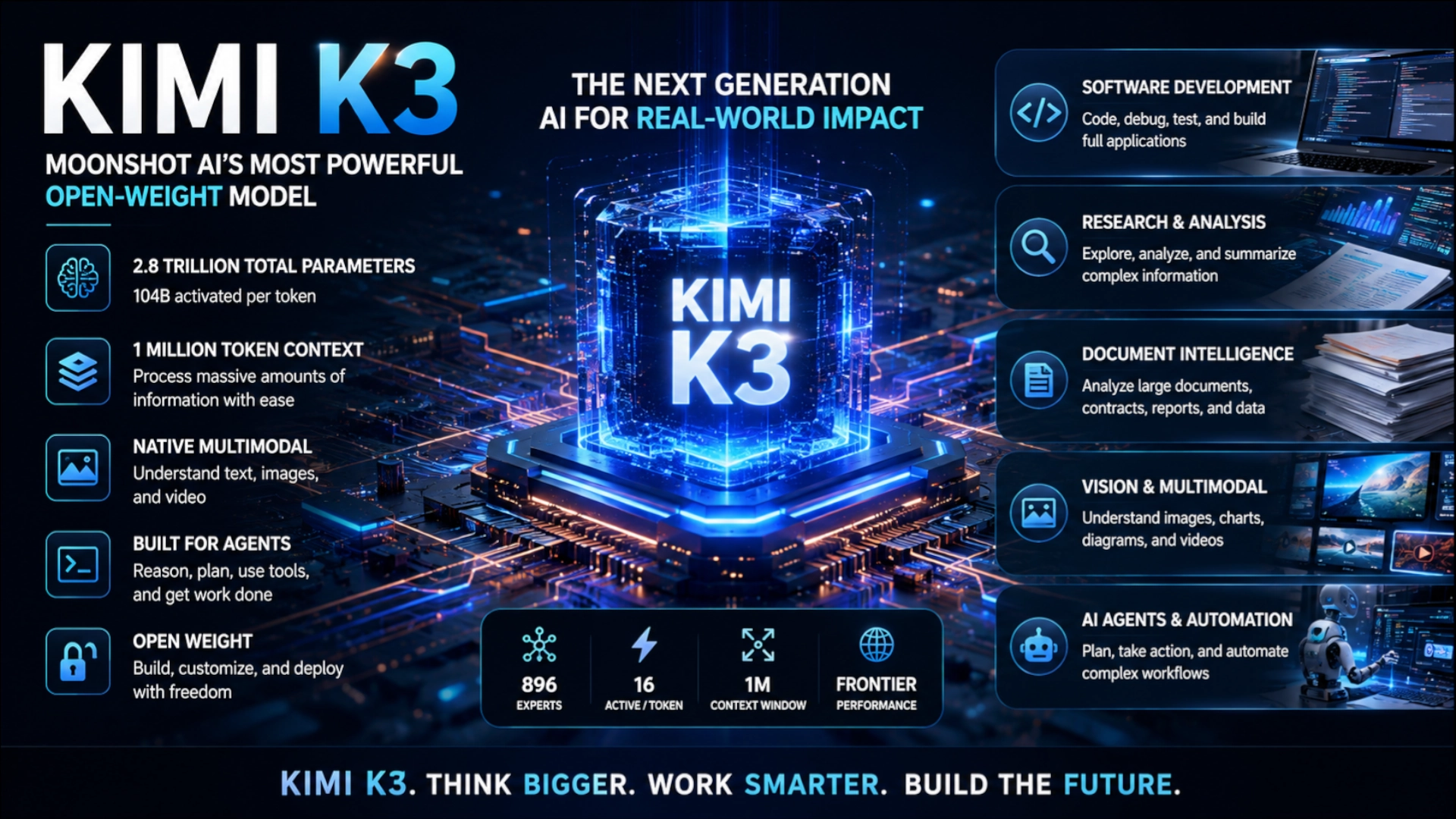
Artificial intelligence is rapidly moving beyond the familiar chatbot.
The next generation of AI systems is being designed not simply to answer questions, but to work through complex tasks, use tools, understand large collections of information, write and modify software, interpret visual content, and continue working toward a goal with less human supervision.
One of the clearest examples of this shift.
Released by Moonshot AI in July 2026, Kimi K3 is a massive 2.8-trillion-parameter Mixture-of-Experts (MoE) model with approximately 104 billion parameters activated during each token, native multimodal capabilities, and a context window of up to one million tokens.
Those specifications alone make it technically impressive. But specifications aren’t the most interesting part of the story.
What makes it important is what models like it could actually do.
What Is Kimi K3?
It is the flagship open-weight artificial intelligence model, designed for reasoning, coding, knowledge work, multimodal understanding, and autonomous AI-agent workflows.
Moonshot describes K3 as its most capable model to date and calls it an “open frontier” intelligence model.
Unlike a traditional language model primarily optimized around a conversation between a person and an AI assistant, this model has been developed with long-running tasks and agentic behavior as major priorities.
That distinction is important.
A conventional AI interaction might look like this:
Human → Question → AI → Answer
An AI-agent workflow can look more like this:
Human → Goal → AI → Plan → Use Tools → Examine Results → Make Decisions → Continue Working → Deliver Result
That second model of interaction represents an increasingly important direction for artificial intelligence.
It was built with that world in mind.
Kimi K3 by the Numbers
Its architecture is enormous.
According to Moonshot AI, the model has:
- 2.8 trillion total parameters
- Approximately 104 billion activated parameters
- 896 routed experts
- 16 experts activated per token
- A 1-million-token context window
- Native text, image, and video understanding
- An architecture based on Kimi Delta Attention (KDA) and Attention Residuals
- Openly released model weights under the Kimi K3 License
The difference between 2.8 trillion total parameters and roughly 104 billion activated parameters comes from the Mixture-of-Experts architecture.
Instead of activating the entire model for every token it processes, the system routes work through a smaller selection of specialized neural-network components, or “experts.”
A simplified way to imagine it is a huge organization containing hundreds of specialized departments.
Instead of asking every department to work on every problem, the system selects the departments most appropriate for the task.
This allows an extremely large model to use its capacity more efficiently.
Moonshot reports that its combination of KDA, Attention Residuals, and a system called Stable LatentMoE provides approximately a 2.5× improvement in overall scaling efficiency compared with Kimi K2.
Check Out These Publications
 |  |
Why the One-Million-Token Context Window Matters
One of Kimi K3’s most interesting characteristics is its enormous context window.
A context window represents how much information an AI model can consider within an interaction.
Kimi K3 supports up to approximately 1,048,576 tokens.
For ordinary conversation, that may sound excessive.
For serious AI work, it can be extremely useful.
Imagine asking an AI to analyze:
a large software repository, hundreds of pages of documentation, technical specifications, research material, previous conversations, reports, spreadsheets, and instructions.
Smaller context windows may require information to be summarized, divided into pieces, retrieved selectively, or discarded as the interaction grows.
A million-token context provides considerably more room for an AI system to maintain information while working through complicated problems.
This is particularly valuable for AI agents, where the model may accumulate large amounts of information as it works.
Practical Use #1: Software Development
Software engineering is one of Kimi K3’s most compelling applications.
Today’s coding assistants are already capable of generating functions, explaining errors, and suggesting fixes.
Agentic coding goes considerably further.
Imagine telling an AI:
“Add a document-upload feature to this application.”
Instead of merely generating an example function, an advanced coding agent could potentially:
- Explore the project’s directory structure.
- Read the existing source code.
- Understand the architecture.
- Determine where the feature belongs.
- Modify multiple files.
- Run the application.
- Execute tests.
- Examine errors.
- Correct its implementation.
- Continue until the feature works.
It was specifically developed for this type of long-horizon engineering work.
Moonshot reports capabilities involving large code repositories, terminal tools, compiler development, GPU-kernel optimization, game development, CAD, and even chip-design workflows.
This represents an important evolution.
The AI isn’t simply writing code.
It is increasingly capable of participating in the software-development process.
Practical Use #2: Research
Research is another natural application.
Consider asking an AI:
“Investigate the current state of humanoid robotics and prepare a report comparing the major approaches.”
Completing that task well requires much more than generating paragraphs.
An AI research agent may need to:
search for information, examine multiple sources, compare conflicting claims, extract relevant data, organize findings, identify patterns, produce tables or visualizations, and construct a final report.
It has been trained for this broader category of agentic knowledge work.
For businesses, engineers, scientists, analysts, and students, models with these capabilities could dramatically reduce the mechanical work involved in gathering and organizing information.
Humans would still need to evaluate sources and verify important conclusions, but AI could handle an increasing portion of the research pipeline.
Practical Use #3: Working With Large Documents
The combination of multimodal understanding and long context makes it particularly interesting for document-heavy work.
Consider a company with hundreds of:
contracts, invoices, manuals, technical documents, policies, reports, presentations, and spreadsheets.
Instead of manually searching through each document, an AI system could potentially examine a large collection and answer questions across it.
For example:
“Find every contract containing an automatic-renewal clause.”
“Compare these engineering specifications and identify inconsistencies.”
“Analyze these invoices and summarize spending by category.”
“Read these technical manuals and create a troubleshooting guide.”
“Compare these reports and identify the most important changes.”
This is where long-context AI begins to look less like a chatbot and more like a general information-processing system.
Practical Use #4: Visual Understanding
It is also natively multimodal.
That means it can reason about more than text.
The model is designed to understand text, images, and video within the same system.
This matters because much of the world’s useful information isn’t stored as clean text.
It exists in screenshots, charts, diagrams, scanned documents, interfaces, photographs, presentations, and videos.
Consider software development again.
An AI agent could potentially:
write interface code → launch the application → inspect a screenshot → notice a visual problem → modify the code → inspect the new result
Vision becomes part of the AI’s reasoning loop.
Similar workflows could be useful for document processing, interface testing, manufacturing inspection, design analysis, robotics, and many other applications.
Practical Use #5: Business Automation
Perhaps the largest long-term opportunity is business automation.
Businesses contain thousands of repetitive workflows that require some combination of reading, reasoning, decision-making, and software interaction.
Examples include:
- processing invoices
- preparing reports
- analyzing spreadsheets
- categorizing documents
- researching customers
- generating proposals
- comparing contracts
- reviewing technical documentation
- preparing presentations
- organizing project information
- analyzing business metrics
Traditional automation works extremely well when every step can be precisely programmed.
AI agents become interesting when the process contains ambiguity.
Instead of programming:
If A happens, execute B.
we can increasingly describe the desired outcome:
“Analyze these documents, identify the relevant information, organize it according to our rules, flag anything uncertain, and prepare the results for review.”
The AI determines many of the intermediate steps.
That is a fundamentally different kind of automation.
Practical Use #6: Building Autonomous AI Agents
It may ultimately be most important as the intelligence behind other software.
Think of the model as the brain of an agent.
The surrounding application provides tools.
For example:
Kimi K3
↓
Browser
↓
Terminal
↓
File system
↓
Database
↓
APIs
↓
Business applications
The model can reason about a goal and decide which tools to use.
An engineering agent might access a terminal and source repository.
A financial agent might use spreadsheets and databases.
A research agent might use browsers and document-processing tools.
A business agent might interact with internal applications and APIs.
This architecture is becoming one of the defining patterns of modern AI.
The LLM provides intelligence.
Software provides capabilities.
Together they form an agent.
Why Open Weights Matter
Another major reason it has attracted attention is that its model weights were released.
Most of the world’s most capable AI models remain proprietary.
Developers access them through applications or APIs, but they don’t receive the underlying model weights.
Open-weight models create additional possibilities.
Researchers can study them.
Companies can potentially deploy them within controlled infrastructure.
This allows organizations to build specialized systems without sending every request to the developer’s hosted service.
Organizations can build specialized systems without sending every request to the model developer’s hosted service.
And the broader AI community can build technology around the model.
This doesn’t necessarily make it “open source” in every traditional software sense—the specific license terms still matter—but releasing frontier-scale model weights is significant.
Can You Run Kimi K3 on Your Home Computer?
For most people, no—not the full model in any practical sense.
This is an important distinction.
“Open weights” does not mean “runs on my laptop.”
Kimi K3 contains approximately 2.8 trillion parameters.
Even though its Mixture-of-Experts architecture activates only part of the network for each token, the model weights themselves are enormous.
Running a model of this scale requires specialized inference techniques and substantial GPU infrastructure.
A developer with an ordinary desktop GPU should not expect to download full Kimi K3 and run it like a 7-billion or 30-billion parameter local model.
For most users, the practical way to access Kimi K3 will be through Kimi’s services, an API, or specialized cloud infrastructure.
That distinction is worth remembering whenever enormous open-weight models are announced.
Is Kimi K3 the Best AI Model?
There isn’t really a single “best AI model.”
Different models excel at different things.
Kimi K3 is particularly notable because it combines several characteristics that rarely appear together:
enormous scale + long context + strong reasoning + coding + multimodality + agentic capabilities + released weights
That combination places it among the most interesting frontier models available in 2026.
Moonshot’s own technical report is also refreshingly important to interpret carefully: the researchers state that Kimi K3 achieves frontier-level results across multiple categories while still trailing the strongest proprietary models overall in their evaluation.
So the interesting claim isn’t:
“Kimi K3 beats every AI model.”
It’s something more consequential:
An open-weight model is operating remarkably close to the frontier while providing capabilities that researchers and developers can build upon directly.
Kimi K3 Shows Where AI Is Going
For years, the dominant way people experienced artificial intelligence was through a chat box.
You typed something.
You typed something.
Kimi K3 represents a different direction.
The emerging interaction is increasingly:
Give AI a goal.
The system then gathers information, reasons about the problem, uses tools, examines results, adjusts its approach, and continues working.
That shift—from answer generation to task execution—may prove much more important than another incremental improvement in chatbot intelligence.
Models such as Kimi K3 suggest that the next major competition in artificial intelligence won’t simply be about which model gives the smartest answer.
It will be about which systems can reliably accomplish useful work.
And that could change how we think about AI entirely.
About Kimi K3
Kimi K3 was developed by Moonshot AI, an artificial intelligence company founded in 2023. The company develops the Kimi family of AI models and assistants and conducts research into large-scale reasoning, multimodal intelligence, long-context models, and AI agents.
Official resources: Moonshot AI’s website, the official MoonshotAI/Kimi-K3 GitHub repository, and the Kimi K3 technical report published on arXiv.
Frequently Asked Questions About Kimi K3
1. What is it?
Kimi K3 is a large-scale artificial intelligence model developed by Moonshot AI. It is designed for advanced reasoning, software development, multimodal understanding, long-context processing, research, and AI-agent workflows. Kimi K3 uses a Mixture-of-Experts architecture with 2.8 trillion total parameters while activating only a portion of the model for each token.
2. Is Kimi K3 open source?
Kimi K3 is best described as an open-weight AI model because Moonshot AI makes its model weights available under the Kimi K3 License. This allows developers and researchers to inspect, deploy, and build systems around the model subject to its license terms. Open-weight does not necessarily mean open source under traditional software definitions.
3. Can I run Kimi K3 locally on my computer?
Running the full Kimi K3 model on a normal desktop or laptop is generally impractical because the model contains approximately 2.8 trillion parameters and requires substantial computing resources. Most individuals and developers will find it more practical to access Kimi K3 through hosted services, APIs, or specialized cloud GPU infrastructure.
4. What can Kimi K3 be used for?
It can be used for software development, AI agents, research, document analysis, multimodal understanding, business automation, data analysis, and other complex knowledge-work tasks.
5. Why is Kimi K3 important?
It is important because it combines several frontier AI capabilities in an open-weight model: advanced reasoning, coding, multimodal understanding, and support for agentic workflows.
Download Kimi K3 here
GitHub MonshotAI Kimi-K3