BitFlip27
The risk is not simply that AI will take jobs. The deeper problem is that many young job seekers are still approaching the market as if the old rules apply. They are earning degrees, sending resumes, and applying online in large numbers, but too often without building the AI literacy, proof of work, adaptability, and human judgment that employers increasingly expect.
That is where the real crisis begins.
This is not a call to panic. It is a warning to prepare.
Recent labor-market reporting shows that entry-level opportunities have become harder to secure, while employers are putting more value on hands-on experience, internships, and career-readiness skills. At the same time, AI is changing the nature of junior work by automating repetitive tasks and pushing entry-level roles toward judgment, analysis, communication, and oversight of AI-assisted workflows.
So yes, Generation Z faces a real adaptation problem. But the truth is important: the issue is not that Gen Z is incapable. The issue is that too many young workers are underestimating how fast the job market is changing.
The truth: AI is changing the ladder, not just the tools
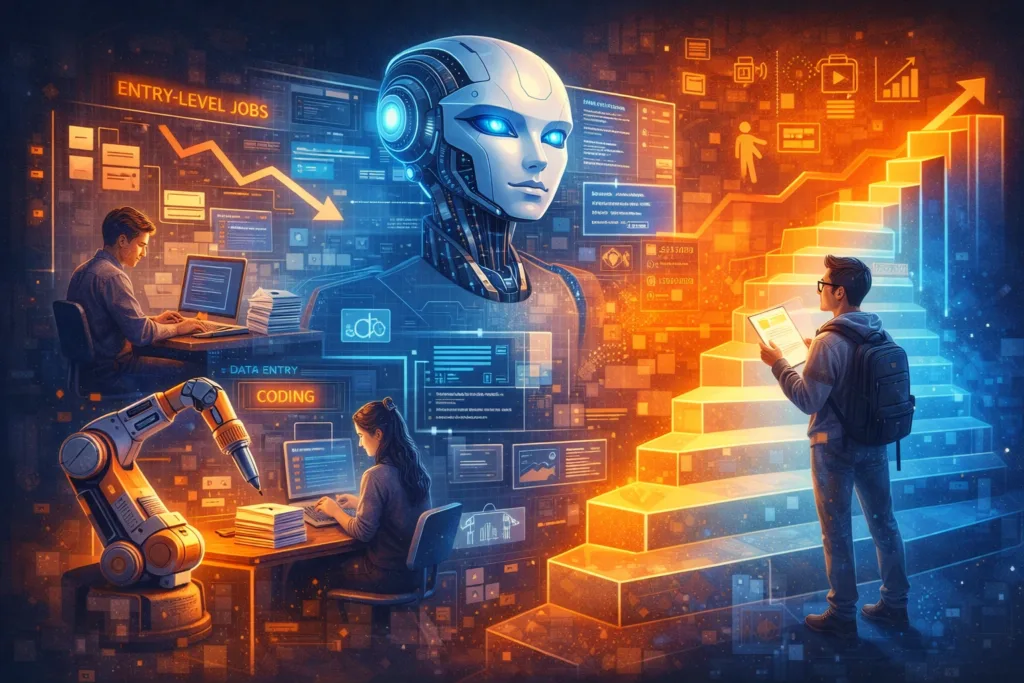
For decades, entry-level jobs often served as training grounds. New workers handled repetitive tasks, learned the business, and gradually moved into higher-value roles. AI is disrupting that model.
According to a March 2026 World Economic Forum article citing Revelio Labs, U.S. entry-level job postings fell by 35% over the last 18 months, in large part because AI is absorbing routine work such as data entry, support tasks, and some coding functions. At the same time, employers still need early-career talent, but they increasingly want people who can use AI responsibly, question its output, and apply judgment rather than simply perform basic repetitive tasks.
That shift matters enormously for Gen Z.
If a young candidate shows up with only classroom knowledge and no evidence of AI fluency, no practical portfolio, and no understanding of how work is being transformed, they may look less prepared than someone who has fewer credentials but stronger adaptability.
Is Gen Z resisting adaptation?
In some cases, yes.
Not every Gen Z worker is resisting change, and sweeping stereotypes are unhelpful. But there are visible patterns that should concern anyone entering the workforce:
Many young candidates still think AI is optional rather than foundational. Some avoid using it because they fear it is “cheating,” while others use it carelessly and let it replace their own thinking. Both mistakes are dangerous.
NACE reported in early 2026 that many students remain cautious about using AI in the job search process. At the same time, employers continue to value practical experience, judgment, and career-readiness skills. NACE also found that most employers are not planning to eliminate entry-level jobs outright because of AI, but the structure of those jobs is clearly evolving.
That means the winning strategy is not to reject AI, and it is not to surrender to AI. The winning strategy is to learn how to work with it better than the next candidate.
Why this matters even more now
The market is already difficult for younger workers.
The U.S. Bureau of Labor Statistics reported that the employment-population ratio for youth ages 16 to 24 was lower in July 2025 than a year earlier, and broader hiring has remained cautious. NACE’s Job Outlook 2026 also describes a leveling-off in employer hiring plans for new college graduates.
In a tighter market, employers become more selective.
When companies hire fewer people, they tend to favor candidates who look ready to contribute immediately. That makes adaptability, initiative, and AI literacy more valuable than ever.
What Generation Z should do right now
1. Learn AI as a work tool, not as a shortcut
AI should become part of your workflow, not a crutch. Learn how to use it for research, drafting, summarizing, brainstorming, coding assistance, data analysis, and organization. But always review, verify, and refine what it gives you.
Employers do not just want people who can type prompts. They want people who know when AI is useful, when it is wrong, and how to turn raw output into something accurate and valuable.
2. Build proof, not just a résumé
A résumé tells employers what you claim. A portfolio shows them what you can actually do.
If you are in marketing, show campaigns, landing pages, SEO audits, prompt workflows, and analytics dashboards.
If you are in software, show code, apps, automations, GitHub projects, and documented problem-solving.
If you are in business, show research memos, market analysis, process improvements, or AI-assisted productivity workflows.
In an AI-shaped market, visible evidence of skill carries more weight than generic claims.
3. Develop judgment
As AI handles more routine tasks, human value shifts toward decision-making, critical thinking, context awareness, and ethical use.
That means young professionals should practice asking better questions:
Is this output correct?
What is missing?
What are the risks?
What should be verified?
How would I explain this to a client, manager, or customer?
These are the habits that separate real professionals from passive tool users.
4. Get hands-on experience early
Internships, freelance work, volunteering, side projects, and apprenticeships matter even more in a market where employers want readiness from day one.
NACE continues to highlight hands-on experience and internships as major priorities for employers hiring new graduates.
Even a small real-world project can be more valuable than another line on a résumé.
5. Improve communication
One of the biggest misconceptions in the AI era is that technical skill alone will be enough. It will not.
Candidates who can explain ideas clearly, write professionally, ask smart questions, and collaborate effectively will stand out more as AI handles basic production tasks.
The more machines generate content, the more valuable strong human communication becomes.
6. Learn the business side of your field
Do not just learn tools. Learn outcomes.
A designer should understand conversion.
A programmer should understand users and business goals.
A writer should understand audience, accuracy, and trust.
A marketer should understand revenue, funnel performance, and measurement.
People who understand business context are harder to replace.
7. Practice responsible AI use
Know the limits of AI. Learn about hallucinations, bias, privacy, copyright concerns, and verification. OECD reporting has noted that generative AI adoption is increasing in businesses, while also raising concerns around legal, regulatory, and workforce-skill issues.
Candidates who use AI recklessly may look fast, but they do not look trustworthy.
What Generation Z should avoid
Avoid treating AI as the enemy
Refusing to learn AI because it feels intimidating or unfair is a losing strategy. The market is changing with or without your approval.
Avoid letting AI do your thinking
Using AI to generate everything for you can quietly weaken your judgment, writing ability, and problem-solving skills. Employers can often tell when a candidate sounds polished but lacks substance.
Avoid résumé-only job hunting
Mass-applying with a generic résumé is becoming less effective. You need targeted applications, real examples of work, and evidence that you can operate in today’s environment.
Avoid sounding entitled to training without showing initiative
Many employers still value teachability, but in a cautious hiring market, they increasingly prefer candidates who already show initiative, curiosity, and self-development.
Avoid being “tool-smart” but “work-dumb”
Knowing how to use ChatGPT, Claude, Gemini, Midjourney, or coding copilots is not enough. You must know how those tools connect to real business problems, deadlines, risks, and results.
The hard message Gen Z needs to hear
Generation Z grew up around technology, but growing up with technology is not the same as being professionally adaptive.
Scrolling, posting, and casually using apps do not automatically translate into workplace readiness. AI is forcing a divide between people who use technology comfortably and people who use it strategically.
That is the uncomfortable truth.
The good news is that this problem can be fixed.
Gen Z does not need to fear AI. It needs to mature with it.
The candidates who will win are not necessarily the ones with the most degrees, the fanciest vocabulary, or the loudest online presence. They will be the ones who can combine AI fluency with human judgment, communication, reliability, and visible proof of work.
Final thought
Artificial intelligence is not closing every door for Generation Z. But it is changing the shape of the doorway.
Those who adapt early will have an advantage. Those who delay, deny, or depend too heavily on AI without developing real ability may find themselves pushed aside in one of the most competitive entry-level markets in years.
The warning is real, but so is the opportunity.
For Generation Z, the message is simple:
Do not compete against AI. Learn to work with it better, more responsibly, and more intelligently than everyone else.
Resources
To better understand how artificial intelligence is changing hiring, entry-level work, and workforce expectations, these sources provide credible research, labor-market data, and practical insight:
National Association of Colleges and Employers (NACE) — Job Outlook 2026
Covers employer hiring projections for new graduates, current labor-market conditions, and hiring trends affecting early-career workers.
https://www.naceweb.org/research/reports/job-outlook/2026/
U.S. Bureau of Labor Statistics (BLS) — Employment and Unemployment Among Youth, Summer 2025
Official U.S. government data on youth employment, unemployment, and labor-force participation for workers ages 16 to 24.
https://www.bls.gov/news.release/pdf/youth.pdf
World Economic Forum — How AI Is Changing the Nature of Entry-Level Work
Explains how AI is reshaping junior roles, reducing some routine tasks, and increasing the need for higher-value human skills.
https://www.weforum.org/stories/2026/03/how-ai-is-changing-the-nature-of-entry-level-work/
OECD — Generative AI and the SME Workforce
Examines how generative AI is affecting skills, productivity, workforce preparedness, and employer expectations in smaller businesses.
https://www.oecd.org/en/publications/generative-ai-and-the-sme-workforce_2d08b99d-en.html
NACE — Trends and Predictions: Job Market
Useful for tracking employer hiring behavior, skills-based hiring, and early talent expectations in a changing market.
https://www.naceweb.org/job-market/trends-and-predictions/
NACE — AI and Entry-Level Jobs: Higher-Level Skills Replace Grunt Work
Helpful for understanding how AI is pushing entry-level roles toward analysis, judgment, and more thoughtful work.
https://www.naceweb.org/talent-acquisition/best-practices/ai-and-entry-level-jobs-higher-level-skills-replace-grunt-work

Título
Geração Z (1997 – 2012) e a verdade sobre a dificuldade de conseguir trabalho na era da Inteligência Artificial
Descrição curta
Neste programa, vamos fazer um alerta sério: o mercado de trabalho já está sendo transformado pela inteligência artificial, e muitos jovens ainda não perceberam a velocidade dessa mudança. A Geração Z corre o risco de chegar atrasada a um mercado mais exigente, mais competitivo e cada vez menos disposto a treinar profissionais despreparados. Vamos falar sobre os perigos de ignorar essa realidade, os erros que podem custar oportunidades e o que precisa ser feito agora para não ficar para trás.
4 perguntas e respostas em português
1. A Geração Z deve estar preocupada com a inteligência artificial?
Sim, e muito. A inteligência artificial não é mais uma tendência distante — ela já está alterando a forma como empresas contratam, avaliam candidatos e distribuem tarefas. Muitos cargos de entrada, que antes serviam como porta de entrada para aprender e crescer, estão sendo reduzidos, automatizados ou completamente reformulados. O jovem que não entender isso agora pode acabar disputando menos vagas, em condições mais duras, contra candidatos mais preparados e mais adaptáveis.
2. Qual é o grande perigo para a Geração Z neste momento?
O maior perigo é subestimar a velocidade da mudança. Muitos jovens ainda acreditam que diploma, currículo básico e conhecimento superficial de tecnologia serão suficientes. Não serão. O mercado está ficando mais seletivo e menos paciente. Empresas querem pessoas que saibam usar inteligência artificial com responsabilidade, pensar criticamente, se comunicar bem e entregar valor real. Quem chegar apenas com teoria e sem adaptação prática poderá ser rapidamente deixado para trás.
3. O que a Geração Z precisa fazer imediatamente para não perder espaço?
Precisa agir agora. Isso significa aprender a usar ferramentas de IA de forma inteligente, construir portfólio, buscar experiência prática, desenvolver pensamento crítico, melhorar a comunicação e mostrar iniciativa. Esperar para “ver o que vai acontecer” é um erro perigoso. O mercado já começou a mudar. Quem começar a se adaptar hoje terá vantagem. Quem adiar essa preparação pode descobrir tarde demais que as oportunidades mais acessíveis já desapareceram.
4. Qual é a mensagem principal para os jovens que querem ter futuro profissional?
A mensagem é simples e dura: ignorar a inteligência artificial pode custar seu espaço no mercado. Não basta gostar de tecnologia, usar redes sociais ou ter familiaridade com aplicativos. É preciso aprender a trabalhar com IA de forma estratégica, profissional e responsável. O futuro não vai esperar ninguém. A Geração Z ainda tem tempo para se preparar, mas esse tempo não deve ser desperdiçado. Quem entender o aviso agora terá mais chances de sobreviver, crescer e se destacar em um mercado cada vez mais exigente.