
 BitFlip27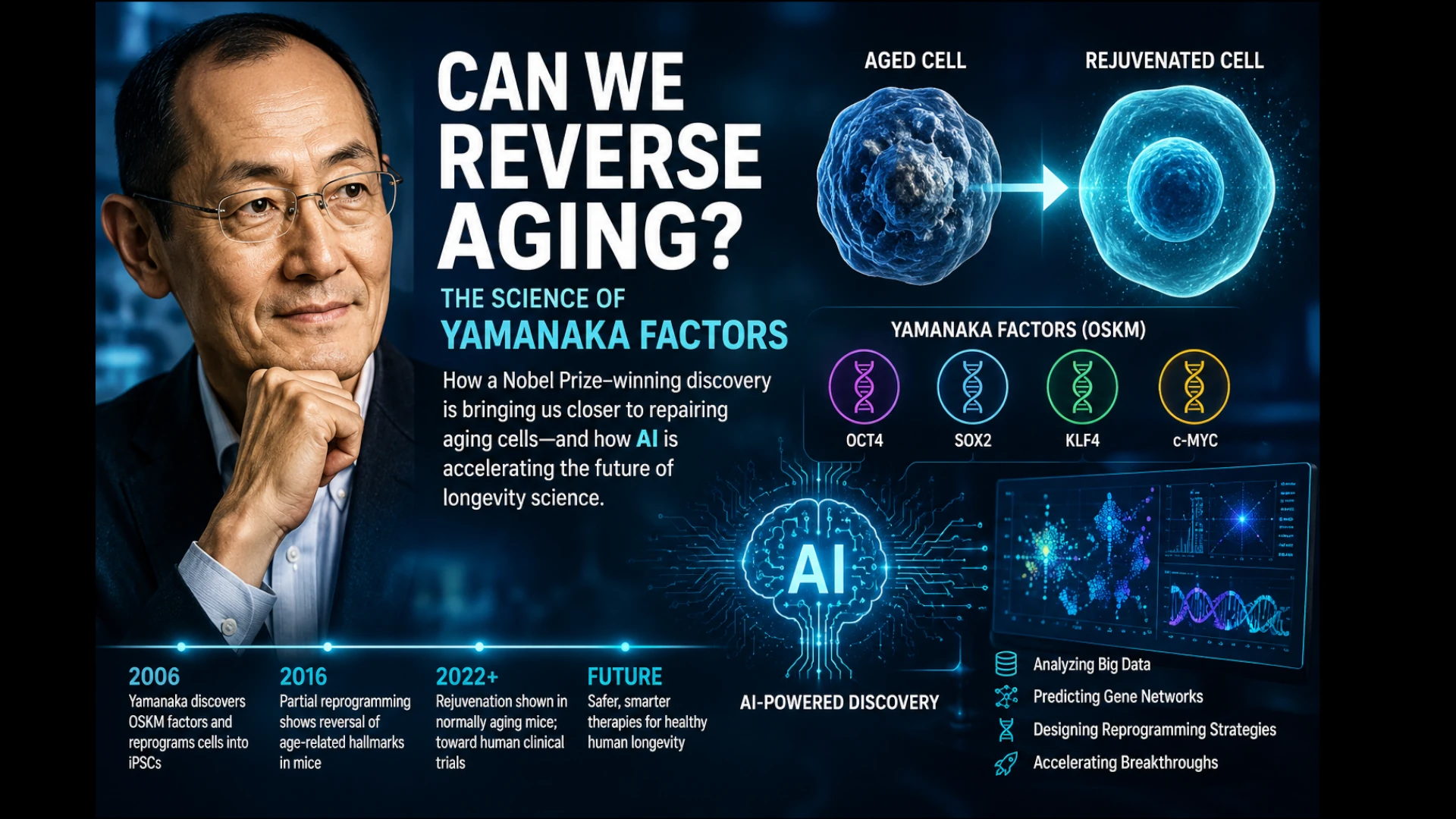
ArtificialRoutine.com | Science & Artificial Intelligence
For most of human history, aging has been regarded as something fundamentally irreversible.
We can treat diseases associated with aging. We can replace joints, control blood pressure, remove cataracts, transplant organs, and increasingly use sophisticated medicines to extend healthy life.
But an old cell?
An old cell was assumed to simply be old.
Then Japanese scientist Shinya Yamanaka made a discovery that fundamentally changed that assumption.
His work demonstrated that mature cells are not permanently locked into their biological state. By activating a surprisingly small collection of genes, scientists can effectively turn back part of a cell’s developmental clock.
Nearly two decades later, researchers are investigating something even more extraordinary: whether the same biological machinery can be controlled without completely resetting the cell, potentially allowing an old cell to recover characteristics associated with younger cells.
And now artificial intelligence has entered the story.
In 2025, researchers at OpenAI and Retro Biosciences reported using an experimental AI model to redesign two of the proteins involved in Yamanaka’s cellular-reprogramming process. In laboratory experiments, the AI-designed proteins produced more than a 50-fold increase in expression of stem-cell reprogramming markers compared with the original proteins.
In 2026, another major milestone arrived: partial epigenetic reprogramming entered human clinical testing. Life Biosciences reported that the first participant had been dosed in a Phase 1 trial of ER-100, an experimental therapy employing three reprogramming factors in patients with optic neuropathies.
None of this means scientists have discovered a cure for aging.
But something profound is happening at the intersection of biology, genetics, regenerative medicine and artificial intelligence.
Here is the science behind it.
Check out these other publications
 |  |
The Discovery That Changed Our Understanding of Cells
The Impact of Shinya Yamanaka on Cellular Rejuvenation
To understand why Yamanaka’s work was so revolutionary, we first need to understand cellular differentiation.
Almost every cell in your body contains essentially the same genetic instruction manual: your DNA.
Yet a neuron behaves completely differently from a skin cell.
A heart-muscle cell is different from a liver cell.
A retinal cell is different from a blood cell.
The difference isn’t primarily that these cells contain different DNA. Instead, cells use different portions of the genetic instructions available to them.
During development, cells become specialized through a process called differentiation.
For many years, scientists largely regarded this process as a one-way street.
Once a cell had become specialized, its identity appeared to be permanently established.
Earlier experiments by British developmental biologist John Gurdon had already challenged that idea. But Yamanaka demonstrated something remarkable in intact mature cells.
His team initially investigated 24 genes associated with embryonic stem cells.
Through systematic experimentation, they discovered that only four transcription factors were necessary to transform mature mouse fibroblasts into cells resembling embryonic stem cells:
OCT4
SOX2
KLF4
c-MYC
Together they became known as OSKM, or more popularly, the Yamanaka factors.
The resulting cells became known as:
induced pluripotent stem cells — iPSCs.
The discovery demonstrated that the identity of a mature cell could be reset.
In 2012, Yamanaka and John Gurdon received the Nobel Prize in Physiology or Medicine “for the discovery that mature cells can be reprogrammed to become pluripotent.”
That distinction is important.
Yamanaka did not originally discover an anti-aging treatment.
He discovered cellular reprogramming.
The connection to aging became clearer afterward.
The Unexpected Connection to Aging
When scientists fully reprogram an adult cell into an induced pluripotent stem cell, something fascinating happens.
The cell doesn’t simply forget whether it was previously a skin cell or another specialized cell.
Many molecular characteristics associated with its age can also be reset.
This suggested an extraordinary possibility:
What if scientists could activate the rejuvenating part of cellular reprogramming without completely erasing the cell’s identity?
Instead of taking:
Old skin cell → stem cell
perhaps researchers could accomplish something closer to:
Old skin cell → younger-functioning skin cell.
That concept became known as partial cellular reprogramming or partial epigenetic reprogramming.
Researchers expose cells to reprogramming factors temporarily or in carefully controlled ways, attempting to restore youthful cellular characteristics while stopping the process before the cells completely lose their identity.
Recent scientific reviews describe partial reprogramming as limited or transient induction of pluripotency factors without allowing cells to reach full pluripotency. Across animal and human-cell experiments, researchers have observed recurring effects on biological processes associated with aging.
That distinction could ultimately prove enormously important.
Your DNA Is Not the Entire Story
Think about DNA as an enormous software repository.
Almost every cell possesses the repository, but different cells run different portions of the code.
The system determining which genes are active, inactive, strongly expressed or suppressed involves something called the epigenome.
The DNA sequence itself does not necessarily need to change.
Instead, biological mechanisms regulate how that DNA is interpreted.
As organisms age, aspects of this regulatory system change.
Gene-expression patterns shift.
DNA methylation patterns change.
Chromatin organization changes.
Cellular stress accumulates.
DNA damage increases.
Mitochondrial function can deteriorate.
Inflammatory signaling changes.
Cells can enter senescence.
The result is not simply an accumulation of chronological years. At the molecular level, old cells behave differently from young cells.
Cellular reprogramming appears capable of resetting at least some of those characteristics.
This has led to a provocative scientific hypothesis:
Some components of aging may represent biological information that can potentially be restored rather than irreversible physical damage alone.
That doesn’t mean all aging works this way.
Aging is extraordinarily complicated, involving many interconnected biological processes. A 2026 review of aging research emphasizes precisely this complexity while identifying partial reprogramming as one of the most promising emerging approaches.
But the possibility that some age-related cellular dysfunction may be reversible has transformed the field.
Partial Reprogramming: Reset Without Erasing
Full cellular reprogramming presents an obvious problem if your objective is rejuvenating an existing organ.
Imagine successfully rejuvenating a heart cell — only for it to forget that it is supposed to be a heart cell.
That’s not useful.
It could be extremely dangerous.
Full reprogramming pushes cells toward pluripotency, where they can potentially develop into many different cell types.
Researchers therefore want something much more precise:
Restore youthful function while preserving cellular identity.
Experiments have provided evidence that this may be possible.
Single-cell genomic studies have found that partial reprogramming can restore more youthful patterns of gene expression, although researchers have also observed temporary suppression of aspects of somatic cell identity.
This illustrates both the opportunity and the challenge.
The biological reset button exists.
Scientists now need to determine exactly how far to press it.
What Has Happened in Animals?
Partial reprogramming has produced intriguing results in animal experiments.
Research has demonstrated improvements in several age-associated characteristics in mice, and subsequent experiments have expanded the range of tissues and disease models being investigated.
For example, a 2025 study using cyclical Yamanaka-factor expression in a mouse model of tauopathy reported improvements in several pathological features in the hippocampus and improvements in spatial memory.
Researchers are studying applications involving neural tissue, regeneration, metabolic disease, vision and other age-related conditions.
Companies including Altos Labs and Retro Biosciences are now pursuing cellular rejuvenation research as a serious biotechnology field. Altos describes its scientific mission around restoring cellular health and resilience, while Retro lists tissue reprogramming among its development programs.
But mouse rejuvenation and human rejuvenation are very different scientific challenges.
Which brings us to perhaps the biggest development yet.
In 2026, Cellular Reprogramming Entered Human Clinical Testing
In January 2026, Life Biosciences announced that the U.S. Food and Drug Administration had cleared its Investigational New Drug application for an experimental therapy called ER-100.
The therapy uses controlled expression of three reprogramming factors:
OCT4 + SOX2 + KLF4
Notice what is missing:
c-MYC.
The company describes ER-100 as part of its Partial Epigenetic Reprogramming platform. The Phase 1 program targets optic neuropathies including open-angle glaucoma and non-arteritic anterior ischemic optic neuropathy (NAION).
Then, on June 9, 2026, Life Biosciences announced that the first participant had been dosed.
The trial is primarily evaluating safety and tolerability, while also examining measurements of visual function.
That is a historic transition.
Partial epigenetic reprogramming has moved from an intriguing laboratory concept and animal experiments into a first-in-human clinical study.
However, this must not be confused with FDA approval.
ER-100 is experimental.
A Phase 1 trial is an early stage of clinical development. Its existence does not establish that the treatment rejuvenates humans, restores vision, extends lifespan or is safe enough for general use.
Those questions require clinical evidence.
And Then AI Entered the Laboratory
This is where the story becomes particularly relevant to ArtificialRoutine.
Yamanaka’s original discovery was not made using artificial intelligence.
His breakthrough came from conventional experimental molecular biology.
It would therefore be inaccurate to say:
“AI discovered the Yamanaka factors.”
It did not.
But AI is accelerating cellular rejuvenation research to help scientists explore and potentially improve the biological machinery Yamanaka discovered.
And a particularly striking example was revealed in 2025.
OpenAI + Retro Biosciences: Using AI to Redesign the Yamanaka Factors
OpenAI and Retro Biosciences collaborated on an experimental AI system called GPT-4b micro, designed specifically for protein engineering.
Instead of merely asking an AI system questions about biology, researchers used the model to propose modifications to biological proteins.
The target?
Two Yamanaka factors:
SOX2 and KLF4.
Protein engineering involves an enormous search problem.
SOX2 contains hundreds of amino acids.
KLF4 contains hundreds more.
Changing the sequence changes how the protein behaves.
The theoretical number of possible protein variants is astronomical — far beyond what researchers could individually manufacture and test.
Traditional experimental approaches can examine only a tiny fraction of that space.
AI can approach the problem differently.
A model trained to understand relationships between protein sequence, structure and function can propose candidates that biological researchers can then manufacture and test experimentally.
The AI does not replace the laboratory.
It helps determine which experiments may be worth performing.
That distinction is crucial.
AI Designed New Versions of SOX2 and KLF4
The experimental model proposed modified versions of SOX2 and KLF4.
Researchers then created those proteins and tested them in actual cells.
The results were striking.
According to OpenAI, the redesigned proteins produced greater than a 50-fold increase in expression of stem-cell reprogramming markers compared with wild-type controls in vitro. OpenAI reported that the findings were replicated across multiple donors, cell types and delivery methods, with derived iPSC lines showing pluripotency and genomic stability.
Researchers called the engineered versions:
RetroSOX
and
RetroKLF.
This represents an important example of what AI-assisted science could look like.
Not:
Human scientist → replaced by AI
but:
Human scientist + AI → candidate biological design → laboratory experiment → measurement → refinement.
AI searches.
Scientists evaluate.
Biology decides.
The DNA-Damage Result May Be Even More Interesting
The researchers didn’t only investigate whether the redesigned proteins could reprogram cells more efficiently.
They also examined a hallmark associated with cellular aging:
DNA damage.
Human fibroblasts were subjected to a treatment that produces DNA double-strand breaks.
Researchers then compared cells receiving conventional Yamanaka factors with cells receiving the AI-engineered variants.
OpenAI reported that cells expressing the engineered RetroSOX/KLF combinations showed lower levels of γ-H2AX, a marker commonly used to assess DNA double-strand-break responses, than cells receiving conventional OSKM in the experiment.
That doesn’t mean AI discovered how to reverse human aging.
But it suggests something extremely interesting:
AI-generated protein designs may improve aspects of cellular reprogramming and potentially some cellular repair responses associated with rejuvenation.
That is a very different — and scientifically much more defensible — statement.
Why AI Could Transform Longevity Research
Biology contains combinatorial problems of staggering size.
Consider just one protein containing hundreds of amino acids.
Changing one amino acid might improve its behavior.
Changing five could make it dramatically better.
Or completely destroy its function.
The number of possible combinations becomes incomprehensibly large.
And proteins are only one level.
Researchers also need to understand:
- gene expression
- epigenetic states
- protein interactions
- cellular signaling
- metabolism
- mitochondrial function
- immune responses
- tissue-specific effects
- drug interactions
- toxicity
- cancer risk
- individual genetic differences
No human scientist can manually evaluate every possible combination.
AI systems can potentially help scientists navigate these enormous biological search spaces.
Instead of testing millions of random possibilities, computational models may increasingly identify promising candidates first.
The laboratory then determines whether the prediction was correct.
This creates a powerful feedback loop:
Biological data → AI model → predicted intervention → laboratory experiment → new biological data → improved model.
The cycle can repeat.
That could compress parts of scientific discovery that once required years of trial and error.
AI May Become a Microscope for Biological Information
The significance extends beyond designing proteins.
Modern biology generates enormous datasets.
Single-cell RNA sequencing can measure gene activity across thousands or millions of individual cells.
Proteomics measures proteins.
Epigenomics examines molecular regulation of DNA.
Spatial transcriptomics can show where gene expression occurs inside tissues.
Longitudinal studies can observe biological changes over time.
AI is particularly well suited to finding patterns across datasets too complicated for humans to analyze manually.
Imagine analyzing millions of cells and asking:
Which molecular characteristics consistently distinguish a 25-year-old cell from an 80-year-old cell?
Then:
Which interventions move the older cell toward the younger state?
Then:
Which interventions accomplish that without causing the cell to lose its identity?
And finally:
Which combination produces rejuvenation without increasing cancer risk?
These are exactly the kinds of multidimensional optimization problems where AI could become extraordinarily valuable.
The Ultimate Goal Isn’t Immortality
Popular headlines frequently describe this research as an attempt to “reverse aging.”
That’s understandable, but scientifically it can be misleading.
The immediate medical objective is much more practical.
Imagine being able to restore function to cells damaged by age.
Potential future applications might involve conditions affecting the:
eyes
brain
heart
liver
muscles
immune system
kidneys
Instead of treating only the downstream symptoms of age-related disease, medicine might eventually attempt to restore healthier cellular function upstream.
That would represent a fundamental shift.
Much of modern medicine asks:
How do we treat the disease produced by damaged or dysfunctional cells?
Rejuvenation medicine asks a different question:
Can we restore the cells themselves to a healthier functional state?
But There Is a Serious Problem: Cancer
Cellular reprogramming is powerful precisely because it changes fundamental cellular programs.
That makes it potentially dangerous.
One of the original Yamanaka factors, c-MYC, is a well-known oncogene.
And excessive or poorly controlled reprogramming can cause cells to lose their identity and potentially produce abnormal growth.
The objective therefore isn’t simply:
more reprogramming.
The objective is:
precisely controlled reprogramming.
Scientists need to determine the correct factors, dose, duration, delivery system, tissue and biological stopping point.
Reviews of partial reprogramming consistently identify oncogenic risk and loss of cell identity among the major barriers to clinical translation.
This is another area where AI could eventually become useful — optimizing therapeutic windows and predicting unsafe molecular combinations — but those predictions would still require extensive experimental and clinical validation.
We Should Be Careful With the Word “Rejuvenation”
A cell can appear younger according to one measurement while remaining old according to another.
Scientists can measure biological aging through multiple indicators, including:
- DNA methylation patterns
- gene expression
- mitochondrial function
- protein homeostasis
- DNA damage
- cellular senescence
- chromatin organization
- inflammatory signaling
Improvement in one biomarker doesn’t automatically mean the entire cell has been restored.
And rejuvenating cells doesn’t automatically mean rejuvenating an organ.
Rejuvenating an organ doesn’t automatically mean rejuvenating an entire human.
Most importantly:
changing biomarkers of biological age is not the same as proving that human lifespan has been extended.
Those distinctions matter enormously.
So, Did Yamanaka Discover How to Repair Aging Cells?
The most accurate answer is:
Not exactly — but his discovery provided one of the most important biological foundations for attempting it.
Yamanaka demonstrated that mature cellular identity is reversible.
Researchers subsequently discovered that controlled or partial activation of reprogramming mechanisms can reverse some molecular and functional characteristics associated with cellular aging in experimental systems.
Scientists are now attempting to harness that phenomenon without allowing cells to lose their identities.
And in 2026, an experimental OSK-based therapy has reached a Phase 1 human trial for specific eye diseases.
References:
- Takahashi & Yamanaka (2006) — Original discovery of induced pluripotent stem cells and the Yamanaka factors
https://pubmed.ncbi.nlm.nih.gov/16904174/ - Ocampo et al. (2016) — “In Vivo Amelioration of Age-Associated Hallmarks by Partial Reprogramming” — Cell. This is one of the landmark studies connecting partial Yamanaka-factor reprogramming with rejuvenation of aging characteristics.
https://pmc.ncbi.nlm.nih.gov/articles/PMC5679279/ - Browder et al. (2022) — “In vivo partial reprogramming alters age-associated molecular changes during physiological aging in mice” — Nature Aging. This study examined partial reprogramming in normally aging mice and reported rejuvenating molecular effects in tissues including skin and kidney.
https://www.nature.com/articles/s43587-022-00183-2 - Capponi & Wang (2024) — “AI in cellular engineering and reprogramming” — Biophysical Journal. This is particularly useful for the AI section of your article. It discusses how AI can analyze single-cell genomics and multi-omics data, model cellular states, identify regulatory pathways, and assist in designing new approaches to cellular reprogramming.
https://pmc.ncbi.nlm.nih.gov/articles/PMC11393708/ - Chemical reprogramming ameliorates cellular hallmarks of aging and extends lifespan — an important newer study investigating whether chemical partial reprogramming can improve aging-associated characteristics, including experiments involving aged human fibroblasts.
https://pmc.ncbi.nlm.nih.gov/articles/PMC12340157/